


Happy Saturday!
This week I spoke at a conference in Vancouver on how to get big projects built in a polarized public opinion environment. On a couple of occasions, I made the point that nothing persuades like in-person engagement, ideally in a one-to-one context. I come at this view for two reasons:
It’s nearly impossible to persuade online. When people see an opposing perspective in the digital environment, they tend to get further entrenched in their own views.
I have so many memories of talking to voters on their doorsteps and being able to move someone from the “undecided” category to the “supportive” camp.
Recent studies have shown that deep canvassing is incredibly effective when done well. The gold standard? Getting the person to empathize with others. But to do that, we need to first empathize with the person we’re speaking with. Which is what we’ll do.
In today’s guide, I offer a sequence of prompts that can help you:
Better understand your target audience.
Place yourself in their shoes
Understand why they may object to your idea/project/campaign
Understand the values that could be driving those objections
Develop questions you could use in these conversations to demonstrate that you are open to hearing their story, with nuanced follow-up questions that can get them to empathize with others who may benefit from your campaign’s goal.
If you want my short take on this concept, I also spoke to it on my new podcast, Business is Politics. Each episode is a snappy ~3 minutes. Take a listen!
Now, let’s get prompting.
Step 1: Put yourself in their shoes
Since this is an exercise in empathy, we need to put ourselves in our audience’s shoes. To help, we’ll get ChatGPT to identify the key moments or cycles in a person’s life, as it applies to the issue we want to engage them on:
Prompt 1:
I am looking to build support for [describe your project or campaign goals].  The [project] is [describe your project, and how it will deliver on the goals].

To help me build public support I would like to better understand potential resistance to the project by empathizing with specific cohorts in the community.

I want to better understand these community members.

Let's start with [describe or name a target audience].  Please help me understand the cycle of a [audience member] who [has attributes that are related to the campaign's issue].

Give me a list of the 3 - 5 significant phases or milestones in this cycle.

Present them from the [audience member's] perspective and keep it succinct.
Since I was inspired to explore this concept at a conference about building new transit infrastructure, I ran with that case study for my example:
I am looking to build support for a new large-scale public infrastructure project in my city. The project is a dedicated bus lane to increase frequency of service. It will result in fewer car lanes for cars.
To help me build public support I would like to better understand potential resistance to the project by empathizing with specific cohorts in the community.
I want to better understand these community members.
Let's start with car drivers. Please help me understand the cycle of a parent who relies on their car on a daily basis.
Give me a list of the 3 - 5 significant phases or milestones in this cycle.
Present them from the parent’s perspective and keep it succinct.
Here’s what I got:
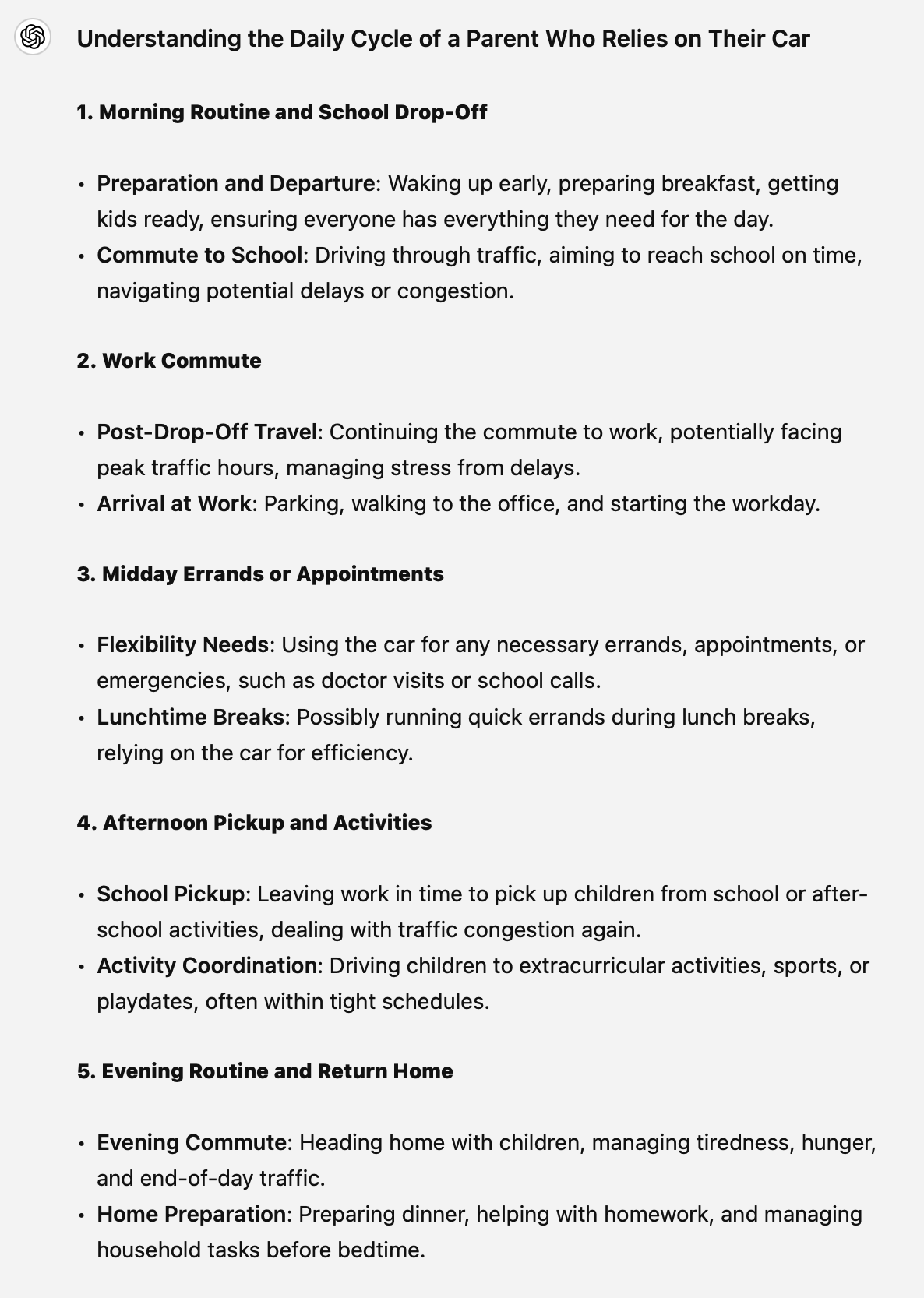
Step 2: Go deep on a specific milestone
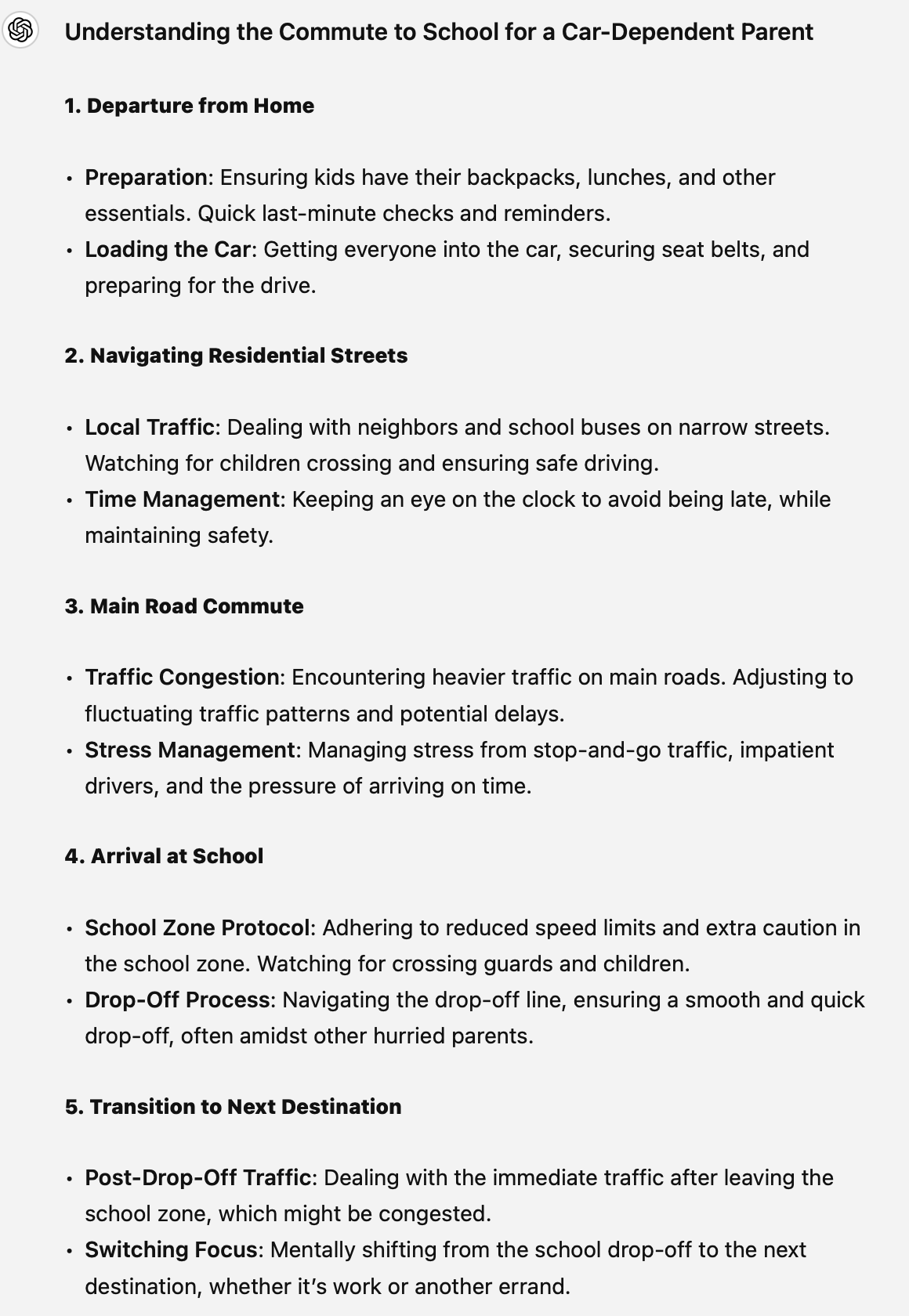
From here, we want to get a bit deeper. I think there could be an interesting opportunity to engage a parent on the topic of commuting to school, so I asked ChatGPT to go further.
Prompt 2:
Take me deeper into the cycle of [pick one of the steps that ChatGPT identified in response to the first prompt].

Give me a list of the 3 - 5 significant phases or milestones in this cycle.

Present them from the [target audiences'] perspective and keep it succinct.
Now we’re getting a much higher resolution picture of our audience’s day. Imagine if you did this for each milestone in the cycle detailed above? You’d understand your audience in a whole new way.
Step 3: Surface areas of resistance
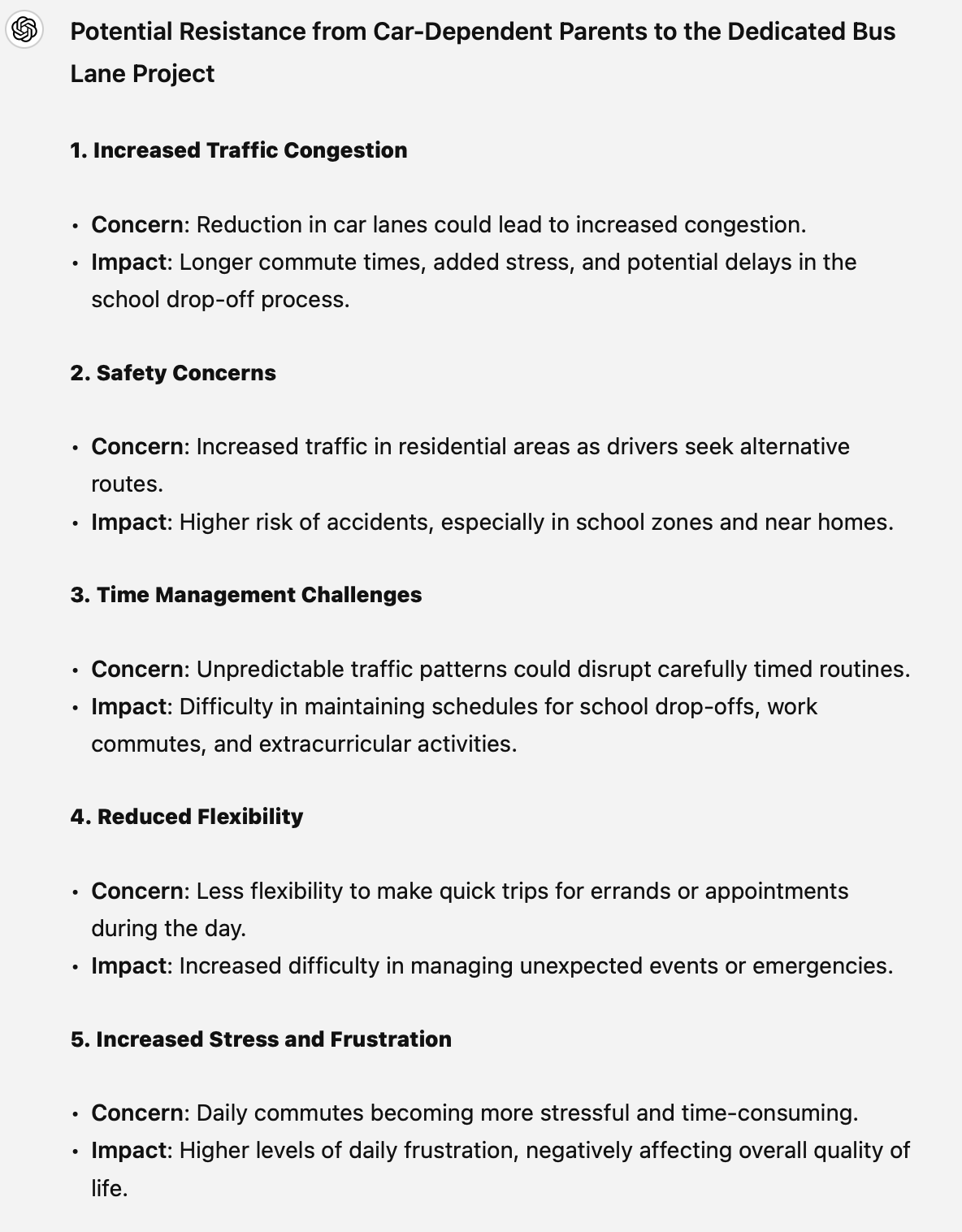
Now the fun work begins. Remember the point of this exercise is to prepare ourselves for difficult conversations from people who are resistant to our idea. In my example, I’m advocating for a new transit way, which will reduce traffic lanes for car drivers. I want to get a better sense of how my audience will perceive this, and what arguments they’ll throw at me.
Prompt 3
Given this, what resistance could these [target audiences] have to the project?When I asked ChatGPT to identify the resistance I might expect from parents who drive cars, I got this:
Step 4: Go beyond the cognitive arguments
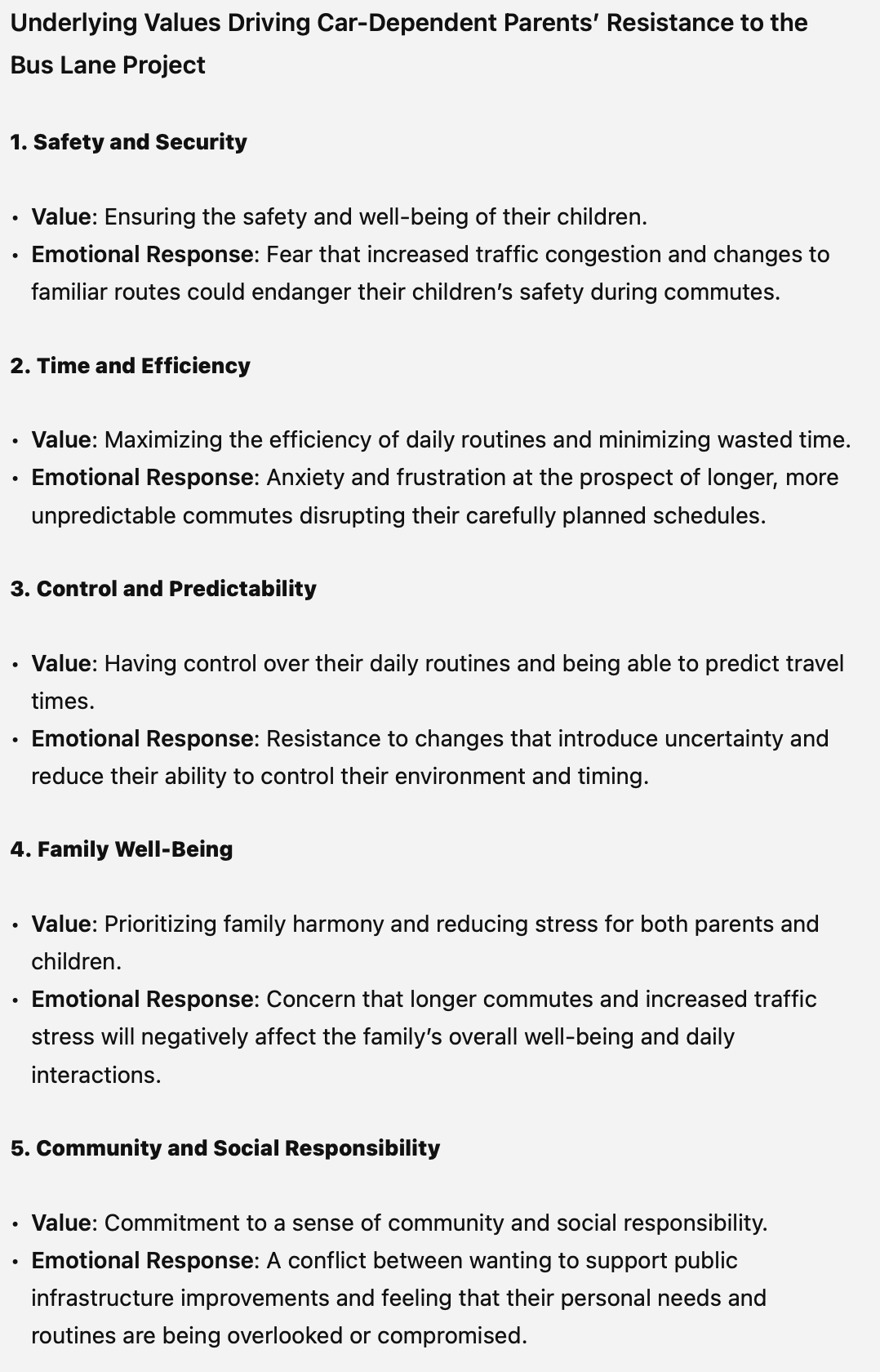
Of course when people use cognitive reasons for justifying their position, it’s always a foil for the real motivations driving their opinion. While there’s no way for ChatGPT to truly understand what values are driving our audience’s thinking, it’s better than a stab in the dark. It can at least prepare us for possible scenarios. So here’s how we extract this:
Often people cite cognitive arguments like the ones you have noted, but these cognitive arguments are rarely the real reason someone is resistant to change. There are usually underlying values that drive an emotional response. What values could be driving these [audience's]' views?I found the output incredibly helpful:
Step 5: Mirror
Now that we have put ourselves in our audience’s shoes, we need to figure out how they can put themselves in the shoes of the people we are advocating for. Ultimately, a good campaign finds a way to advocate for everyone and speaks to how everyone will be better off, even if they are not the direct beneficiary of a campaign’s outcomes. This is where empathy makes all the difference.
Prompt 5:
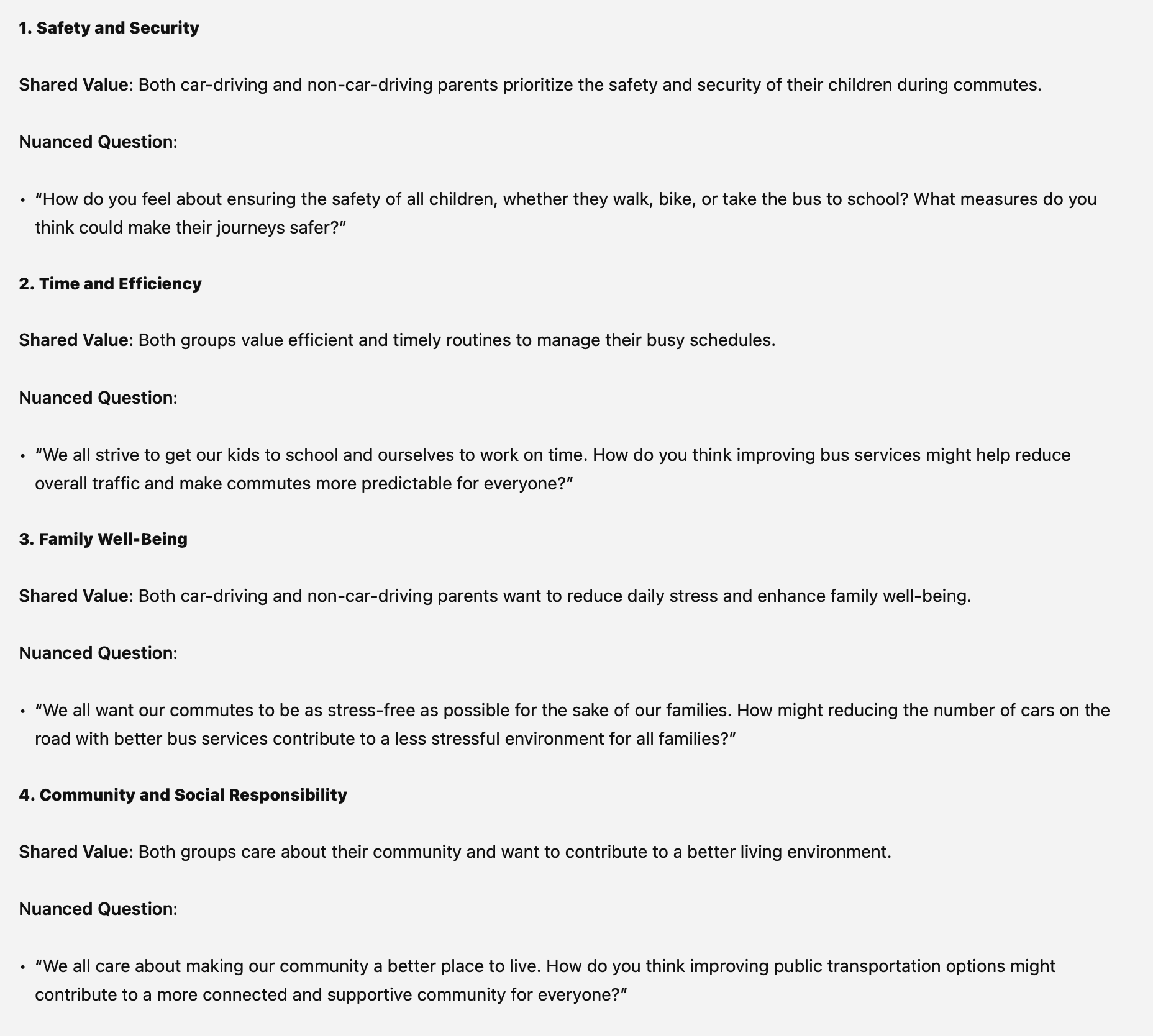
In my conversations with these [audiences], I would like to find an elegant way to have them put themselves in the shoes of people who [explain what makes the opposing side different]. What shared values would [your target audience]have with [opposing audience]? For each of these shared values, can you recommend nuanced questions I could use in my conversations to have them empathize with [opposing audience]?In my example, I want car-driving parents to put themselves in the shoes of parents who rely on public transit. Here’s how my prompt read:
In my conversations with these parents, I would like to find an elegant way to have them put themselves in the shoes of people who do not use cars. What shared values would car-driving parents have with non-car-driving parents. For each of these shared values, can you recommend nuanced questions I could use in my conversations to have them empathize with non-car-driving parents?
Here’s a snapshot of what I got:
Step 6: Make it personal
To be truly effective, I would ideally have the person tell me a story that relates to how they came to hold their views. By me being interested in that person, I can build trust, and it helps them think out loud.
Prompt 6:
I would like to prompt these people to tell me personal stories that I can use bridge to the questions you have identified above. Can you provide me with some questions I could use to surface personal stories?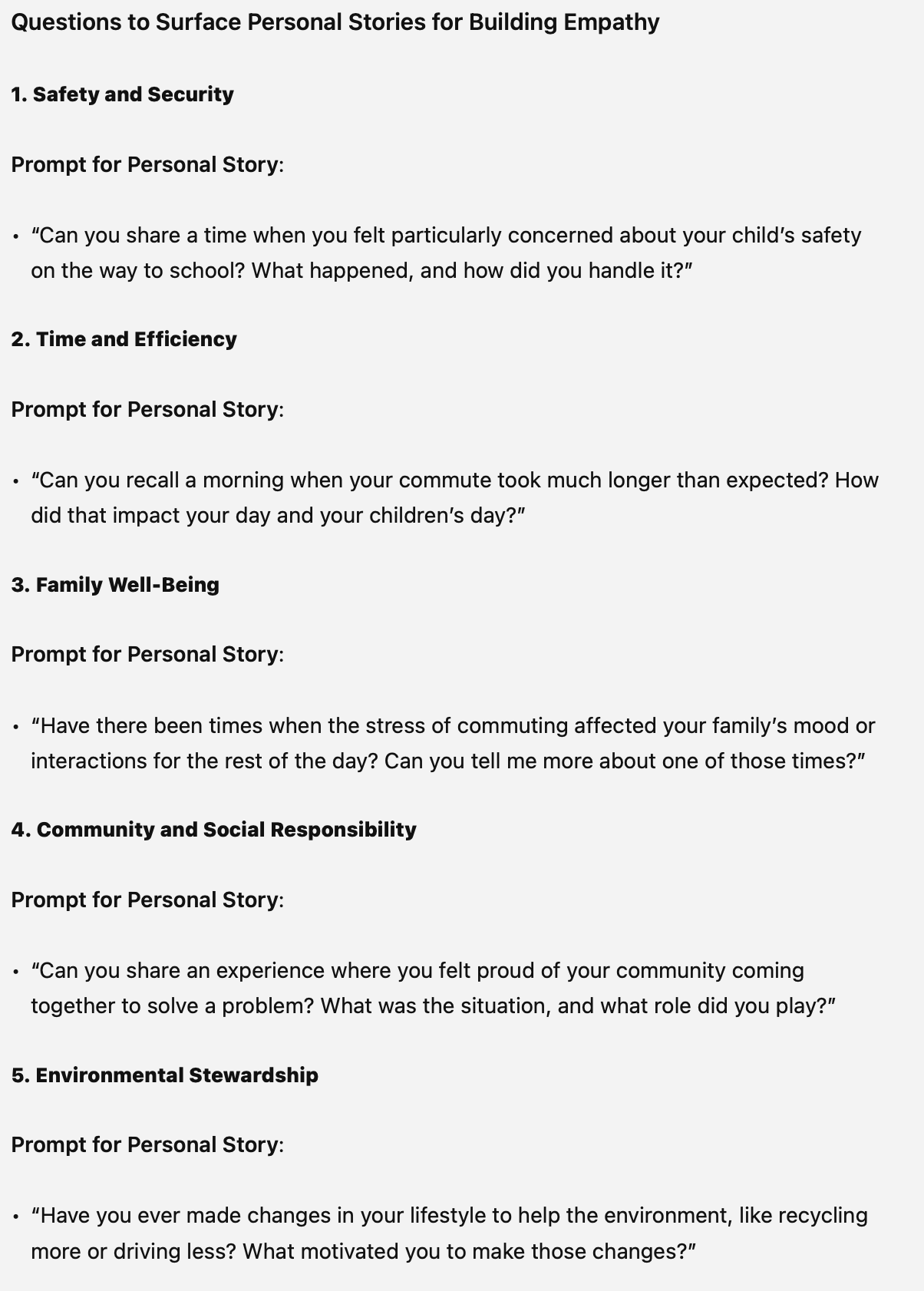
Step 7: Organize
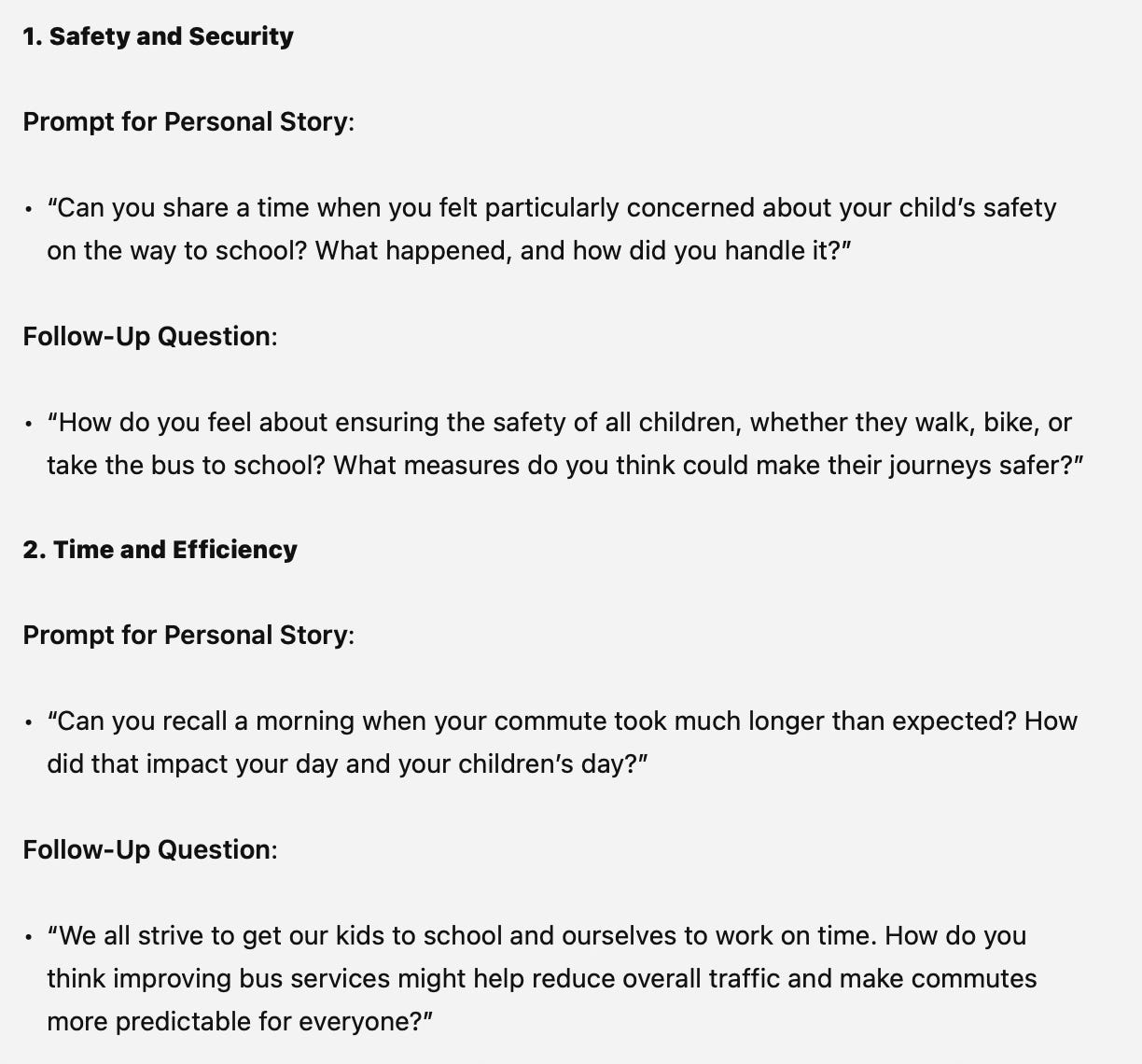
I now want to combine steps 5 and 6 into a cohesive archive of values/concerns and questions I could use to prompt people into sharing their stories with me.
Prompt 7:
Can you combine these questions with the previous ones so that I have an easy to read script?Here’s a snapshot of what I got:
And that’s it! You can repeat these steps for each of the milestones in your audience’s cycle and then repeat for all of your target audiences. Compile the results and you havre yourself a helluva canvass script guide, or some questions you can use to guide outbound messaging.
If you made it this far, I’d love your feedback on how you enjoyed this week’s guide!