I was inspired to write this week’s guide after spending an evening in London with some public affairs pros who have been experimenting with AI to produce high-touch communications products. One of the use cases we reviewed? Using AI to produce a Message House. I was intrigued by this and went off to experiment.
What is a “Message House” in corporate communications?
It’s a strategic framework used to ensure your messaging is clear, consistent, and effective across all your distribution channels and target audiences. It’s a useful tool for getting your team to align on internal and external communications, providing a unified narrative that supports your communications objectives.
Structure of a Message House
The Message House is often visualized as a house with three components:
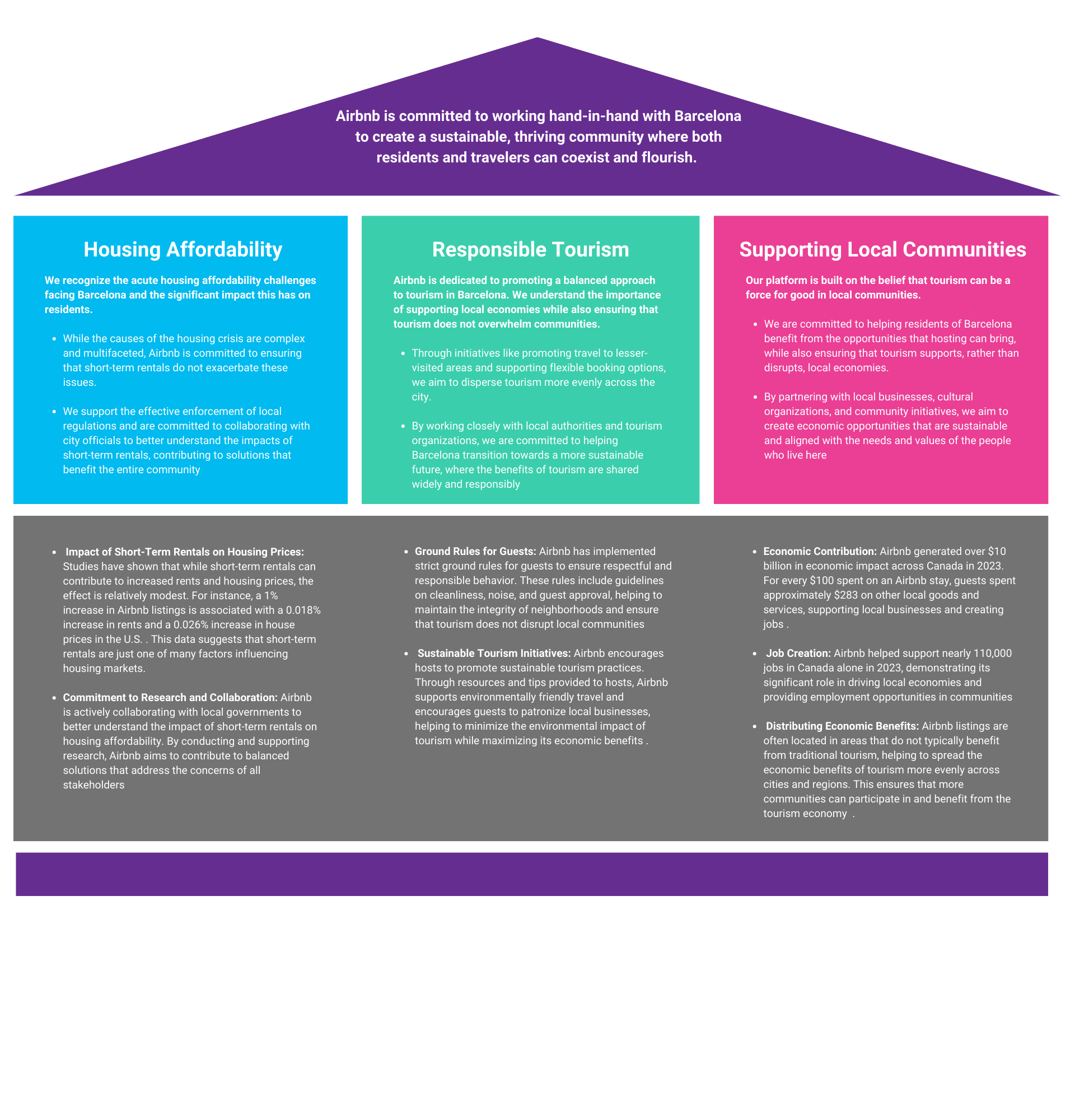
Roof (Key Message or Theme): This is the overarching message or central theme that encapsulates the core idea you want to communicate. It’s your elevator pitch or main narrative. It needs to be memorable and compelling.
Walls (Supporting Messages): These are your main pillars that support the key message. Usually, there are three to four supporting messages that elaborate on different aspects of the key message, providing additional context and detail.
Foundation (Proof Points): This is where your data, proof points, data, and supporting examples live. They add credibility and make your message more persuasive.
Benefits of using a Message House
Clarity and focus: The Message House helps distill complex information into a clear narrative, making it easier for your team to communicate.
Consistency: The structure ensures your communicators and products are aligned and sing from the same song sheet.
Flexibility. You can adapt the details within the core structure to suit different audiences and situations (e.g. media interviews, internal communications, campaigns, etc.)
A Workflow for writing a Message House
Here’s how you would typically develop a message house:
Define the key message: Start with a clear, concise statement that captures what you need or want to communicate. It should be compelling and easy to remember.
Develop supporting messages: Identify the main points that support your key message. These should provide additional detail, covering the main components of your key message.
Identify supporting proof points: Gather evidence, data, and useful examples that validate your supporting messages. These should be factual and verifiable.
Taking it up a notch with AI
Now that we’re aligned on what we’re working towards, let’s build a Message House using AI. Given the need for verified facts and data, we’ll use a combination of ChatGPT and Perplexity AI to build this out.
As always, I like working with a real-world example. For this one, I thought we could develop a hypothetical Message House for Airbnb as it confronts ongoing protests in cities like Barcelona, where locals have become deeply frustrated by the negative impact of tourism, especially on long-term housing supply.
Step 1: Provide ChatGPT with an issue brief
I need your help writing a Message House on my public affairs issue.

I will provide a detailed review of the issue below. Please read it and let me know when you are ready to begin, but do not do any work until you get further instruction from me.

Issue Brief
[Explain your issue in detail]
For my example, this is how the issue brief read:
Airbnb is facing local protests in Barcelona due to several interconnected issues related to overtourism and its impact on the city's housing market and local community. Here are the primary reasons:
Housing Crisis and Rising Rents
One of the main grievances is the significant contribution of short-term rentals to Barcelona's housing crisis. The proliferation of Airbnb-style accommodations has led to a reduction in the availability of long-term rental properties, driving up rents and making housing unaffordable for many residents. This issue has been exacerbated by the conversion of residential units into tourist accommodations, which has displaced local residents and workers. Barcelona's mayor, Jaume Collboni, has identified the housing shortage as the city's biggest problem and announced a ban on short-term rentals by the end of 2028 to address this issue.
Overtourism and Community Disruption
Barcelona has been struggling with overtourism, which has overwhelmed local infrastructure and disrupted the daily lives of residents. The city, which receives millions of tourists annually, has seen its public spaces, like Park Güell, and neighborhoods transformed by the constant influx of visitors. This has led to overcrowding, increased noise levels, and a shift in the local economy towards catering to tourists rather than residents. The frustration among locals has been palpable, with protests involving water pistols and blocking access to tourist spots as a form of demonstration against the overwhelming number of visitors.
Economic and Social Impacts
While tourism brings significant revenue to Barcelona, the economic benefits are often offset by the social costs. The surge in short-term rentals has led to the closure of local businesses that cater to residents, replaced by tourist-oriented establishments. This shift has altered the character of neighborhoods and contributed to a sense of loss among long-term residents. Additionally, the jobs created by the tourism industry are often low-paid and precarious, contributing marginally to the local economy.
Regulatory Measures and Public Sentiment
In response to these challenges, Barcelona's local government has implemented strict regulations on short-term rentals and increased the tourist tax to fund local projects. Despite these efforts, public sentiment remains divided. While some residents acknowledge the economic benefits of tourism, there is a growing call for more sustainable and fair tourism practices that prioritize the needs of the local community over those of tourists[7][8].
In summary, Airbnb is dealing with local protests in Barcelona due to the adverse effects of short-term rentals on the housing market, the disruption caused by overtourism, and the broader economic and social impacts on the local community. The city's efforts to address these issues through regulatory measures reflect a broader trend of cities worldwide grappling with the balance between tourism and resident well-being.
Step 2: Explain who the Message House is for
Now we need to get ChatGPT into our frame of mind. If you simply ask it to write a Message House, it has no idea who it is writing it for. Is it for your client? Your organization? The other side? We need to guide it along. Here’s how that looks:
You are a seasoned corporate communicator and you will help me write a Message House for [organization] on this issue. We will break this down into steps so that we can develop a quality product. Here are the steps we will follow:

1. Define the key message: Start with a clear, concise statement that captures what you need or want to communicate. It should be compelling and easy to remember.
2. Develop supporting messages:  Identify the main points that support your key message. These should provide additional detail, covering the main components of your key message.
3. Identify supporting proof points: Gather evidence, data, and useful examples that validate your supporting messages. These should be factual and verifiable.

Are you ready to proceed with step 1? Please do not skip ahead to steps 2 or 3 until I ask you to.
Step 3: Write the key message with ChatGPT
ChatGPT should confirm that it is ready to begin work and may ask you if you have additional information or considerations to follow. In my example, I told it I wanted it write in the style of Brian Chesky, one of Airbnb’s co-founders.
Here’s what I got:
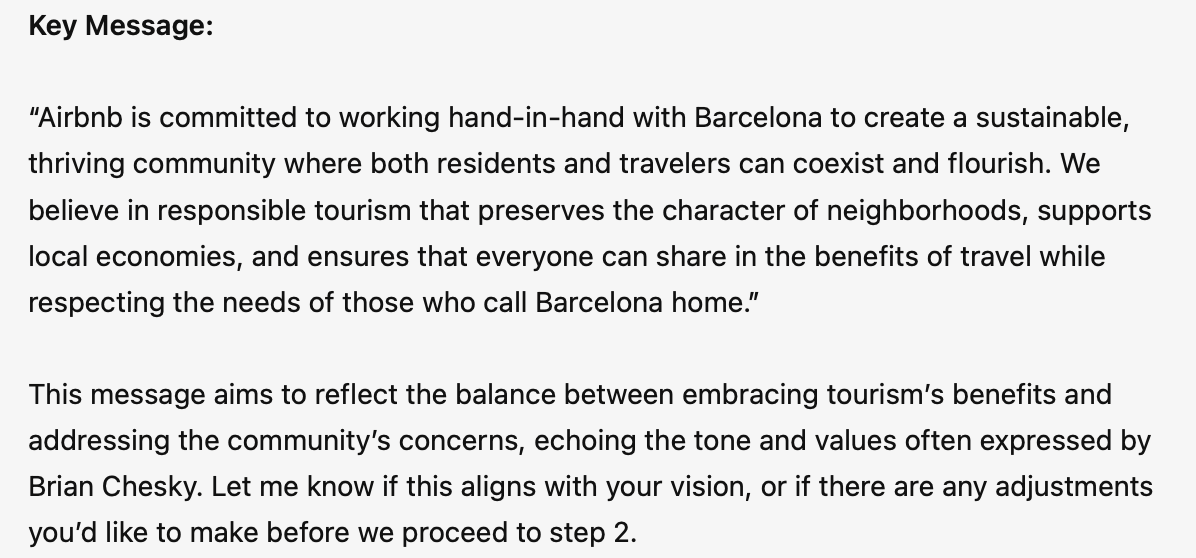
It seems to hit the right notes on first blush:
Commitment to working with the city
Recognition of the need for a sustainable solution
Recognize the need for traveler and locals to co-exist.
If you’re curious, here is how the real Brian Chesky recently addressed the issue:
Step 4: Write supporting messages with ChatGPT
I was curious to see what pillars of the house ChatGPT would develop on its own. So I agreed to let it proceed to step 2 and got this:
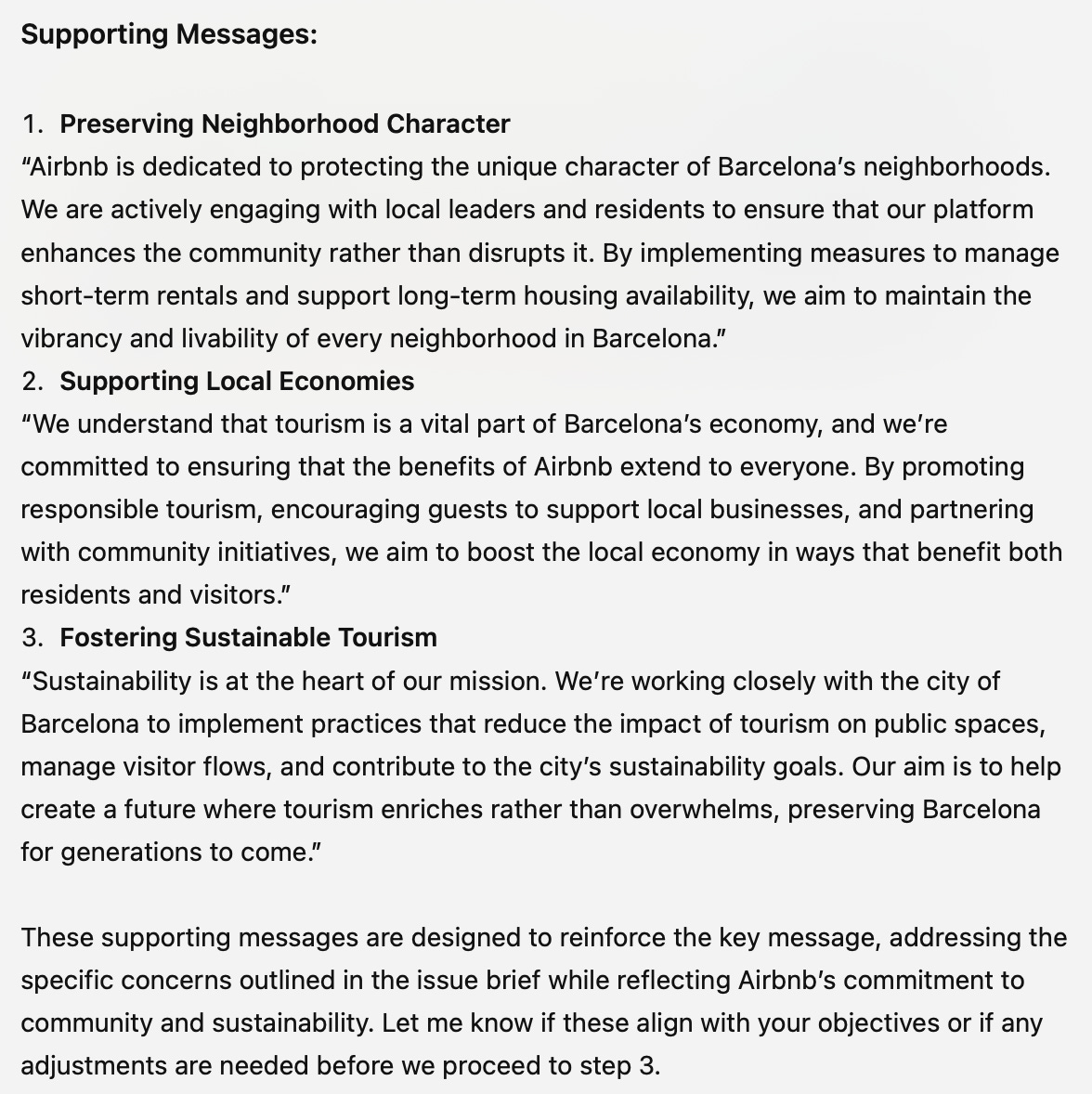
Step 5: Edit the supporting messages to match your needs
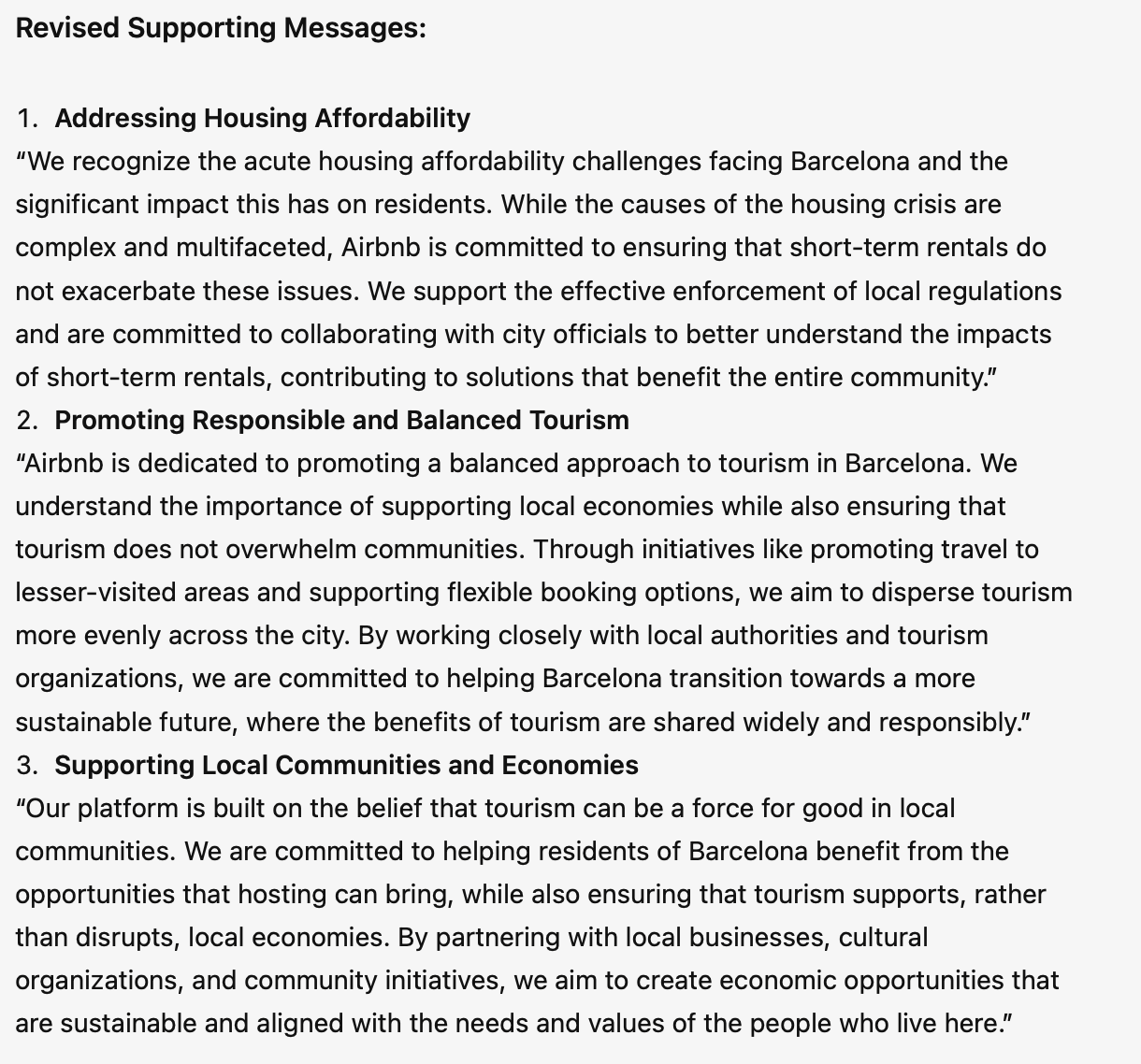
While there’s nothing wrong with these, they obviously make a series of policy choices that may or may not be in line with reality. To avoid this with your own Message House, I would equip ChatGPT with a copy of your policy briefing. For now, I found language Airbnb has used on the topic and asked ChatGPT to edit accordingly. The result is a big improvement:
Step 6: Work with Perplexity AI to find supporting data
By now you know that I love using Perplexity AI, especially when I need to find verifiable data and information. So, I hopped over to Perplexity and fed it this prompt in the Pro setting:
I am writing a Message House for Airbnb to respond to Barcelona's attempt to ban short-term rentals from the city. I need supporting data and evidence to demonstrate how Airbnb addresses housing affordablity, promotes responsible and balanced tourism, and supports loval communities and economies.
Here’s what I got. I copied this and took it to ChatGPT.
Step 7: Provide the supporting data to ChatGPT
Let's proceed to step 3. Here is the information to help you:

[paste results from Perplexity]
And with that, within minutes, you have a draft message house. At the end of the day, this is a solid draft. I personally find the messages too wordy and would edit them or continue to work with ChatGPT to refine, offering style guidelines. I’d also start this exercise with a copy of a brand documents, positioning language, and other documents that would help ChatGPT write to my preferred style. However, given how little it had to work from, I found ChatGPT delivered well.
Here’s how my sample Airbnb Message House reads on first blush.