


In public affairs, access to accurate and timely information is crucial. When you’re navigating the complex landscape of policy, public sentiment, and media, you need answers and context at the click of a button.
For decades, traditional search engines like Google have been the go-to for desktop research, but AI-driven search tools are changing the game. In early 2024, Perplexity AI is the leader in AI-driven search, and a tool I’ve added to my tech stack.
Why?
Because as a public affairs practitioner, I can’t rely on surface-level information. I need deep insights, precise data, and the ability to connect seemingly disparate dots across a vast information landscape. Increasingly, I can’t get this from traditional search engines. And I’m not the only one.
This is where Perplexity AI comes into play, offering a nuanced and focused search experience tailored to the needs of professionals in the field.
This week, we will learn:
How Perplexity AI can transform research and information gathering for public affairs.
The distinct advantages of Perplexity AI over traditional search engines like Google.
Practical tips for incorporating Perplexity AI into your desktop research workflow to maximize its benefits.
Let's dig in and learn how to make Perplexity AI an indispensable tool.
Understanding Perplexity AI
Unlike traditional search engines that rely heavily on keyword matching and historical click-through data, Perplexity AI uses machine learning algorithms to understand the intent behind a query, offering answers that are relevant, and often, deeply informative.
At its core, Perplexity AI is designed to think more like a human and less like a machine. It processes queries by evaluating the context and nuances of each request, pulling from a wide range of sources to present answers that are comprehensive and directly address the user's needs. This level of analysis and understanding is particularly beneficial for public affairs practitioners, who require detailed insights into policies, public opinion, and legislative changes.
How it works: The technology behind Perplexity AI is built on a foundation of large language models and natural language processing (NLP), enabling it to comprehend, reason, and provide responses in a way that feels intuitive to users.
What it means: when you ask Perplexity AI a question, it doesn't just search the web for matching phrases; it analyzes a wide array of sources to present an answer that reflects a comprehensive understanding of the topic.
The Advantages of Perplexity AI for Public Affairs Practitioners
To illustrate this difference, let's consider this use case: researching the impact of renewable energy policies on local economies.
You know all too well how this works in Google:
You type in “What’s the impact of renewable energy policies on local economies”.
You’re presented with a page filled with ads, links, news, photos, articles.
You then need to click through many of these links, on the hunt for the information you need, evaluating their relevance and credibility.
And then you need to synthesize this information manually.
In other words, while Google's search is invaluable for accessing a broad range of sources, it requires significant time and effort to extract actionable insights.
In contrast, asking Perplexity AI the same question results in a concise, informed response that synthesizes information from multiple sources:
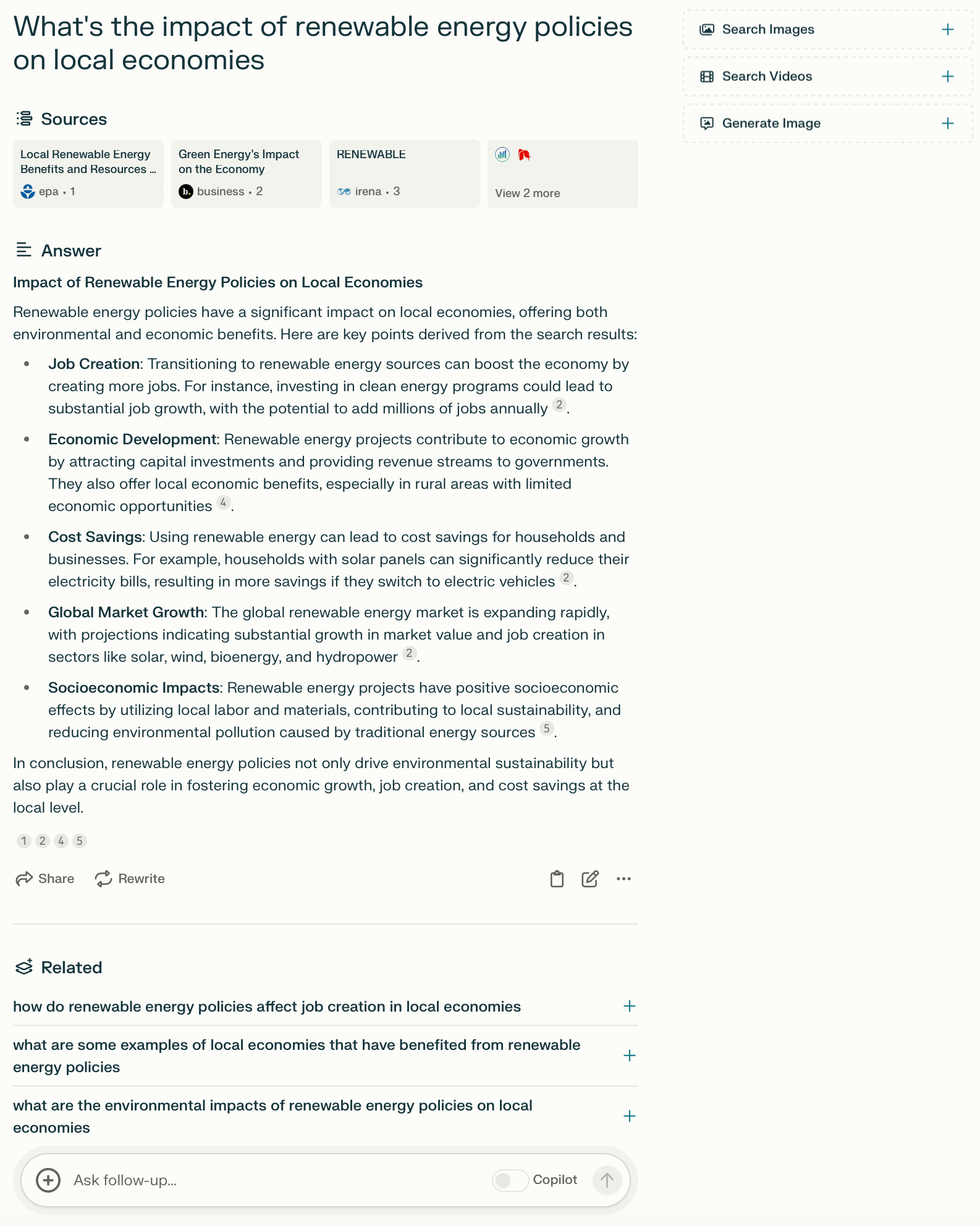
Here’s what we get:
A synthesized answer, with a robust bulleted list of supporting arguments.
Each bullet has a citation, which you can click on to access the original document, giving you confidence that the answer is not a hallucination.
And the ability to ask follow-up questions, with some thought starters to help you explore the topic quickly.
This is a huge time saver.
For me, the best feature is the ability to ask follow-up questions, which are informed by, and build on the original question. The result is an ability to get deeper and deeper, with crucial context and learning with each query.
Why it matters: The more you engage and follow-up, the more contextually-appropriate answers you get.
You can see how I went down the rabbit hole with my query on impact of renewable policies on local economies here. This entire stream is much more useful than the output I would get if I went down this same rabbit hole on Google.
It’s also more useful than what I could get out of ChatGPT, because every output is filled with direct links and reference material. I don’t need to conduct a separate/manual fact checking exercise as I would have to with ChatGPT.
Take a look at how ChatGPT answers my original query:
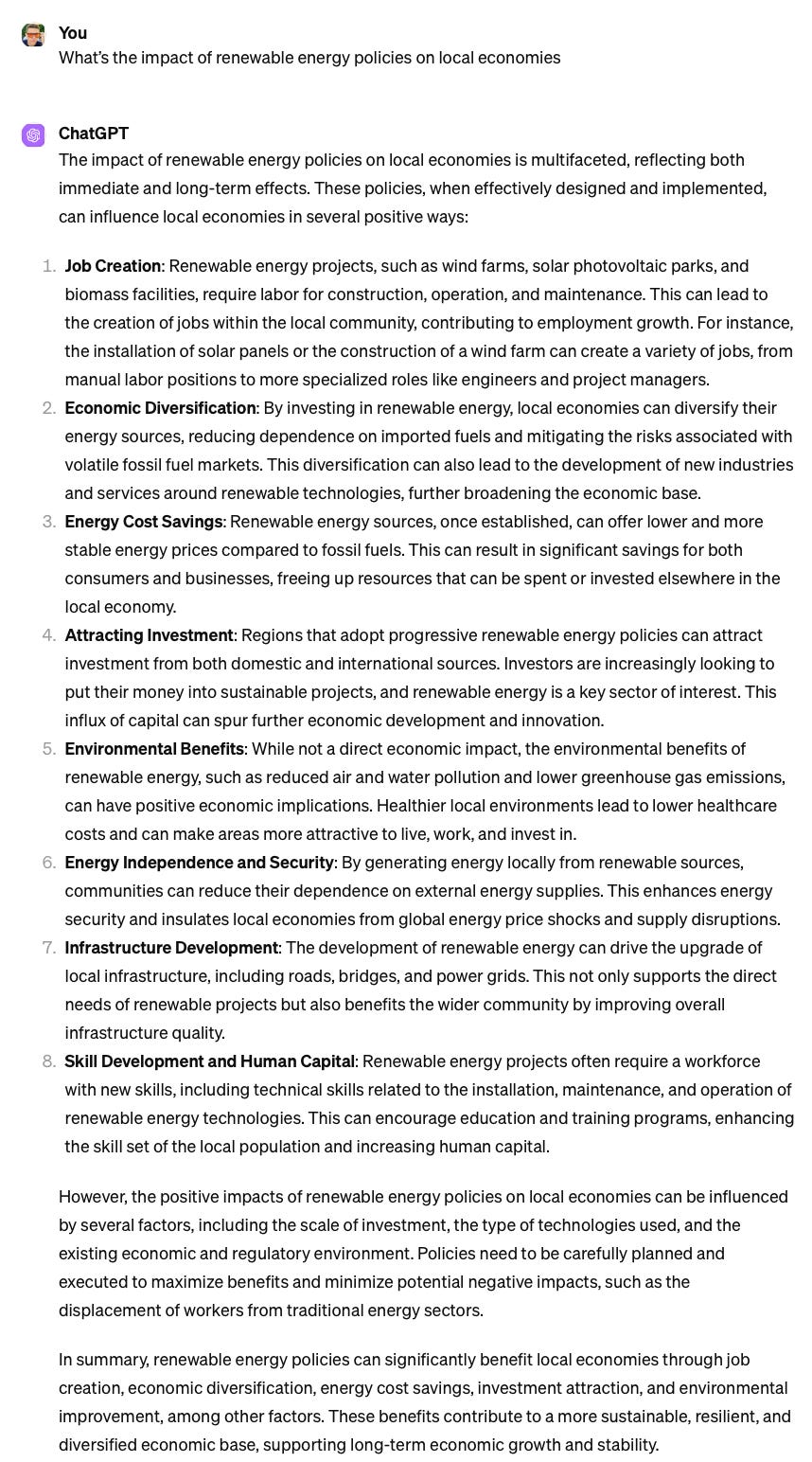
You’ll notice a lot of overlapping content. You might even say that ChatGPT’s answer is more robust and detailed. This is true if my use case is content generation. But if my use case is to research a topic, and access source material quickly, I suddenly need to take the output from ChatGPT and Google the core arguments to find supportive materials. That’s a huge drag on time.
If your use case is content generation, stick with ChatGPT. If your use case is factual accuracy, use Perplexity AI.
And that’s because Perplexity AI has a deeper knowledge base, with access to webpages, documents, and datasets.
This ability to connect related concepts and present them in a cohesive summary is very helpful in giving me understand the broader context.
How Perplexity AI Complements Traditional Search Engines
While Perplexity AI offers distinct advantages for deep, contextual searches, it won’t fully replace Google. I see them as being complementary. When used together, they can significantly enhance my research capabilities. Here’s why:
Google's strength lies in its vast index of the web, providing access to an unparalleled breadth of content. It's particularly useful for initial exploratory searches, finding specific websites or documents, and staying updated on recent news and publications. Google excels in offering a wide lens on the world, making it indispensable for gathering a comprehensive set of sources.
Perplexity AI, on the other hand, shines in its ability to digest, synthesize, and present information in a manner that directly answers complex queries. This makes it an ideal tool for delving deeper into topics, understanding nuanced issues, or obtaining a summarized overview of a subject matter. It acts as a filter and synthesizer, transforming the vast information landscape into digestible, relevant insights.
Here are four strategies for using Perplexity AI with Google:
Initiate with Perplexity AI for targeted insights: Begin your research journey with Perplexity AI to ask specific, complex questions related to your public affairs interests. This approach allows you to quickly grasp nuanced understandings and obtain summarized insights without sifting through countless pages.
Use Google for source exploration: After gaining insights from Perplexity AI, use Google to locate specific sources, additional research papers, or news articles mentioned or implied in Perplexity AI's responses. This step is crucial for deepening your research, sourcing original documents, and exploring further information on the topics at hand.
Cross-verification and deep dives: Use Google for verifying facts and exploring more diverse viewpoints on the information provided by Perplexity AI. This helps ensure a well-rounded understanding and captures the breadth of the discourse surrounding your topic.
Leverage Perplexity AI for complex queries and follow-ups: As you uncover more about your topic through Google, return to Perplexity AI with refined, complex queries based on your new findings. This iterative process can reveal deeper insights and foster a more comprehensive understanding of intricate issues.
Incorporate both tools into routine monitoring: Use Google Alerts to monitor the latest developments in your areas of interest and rely on Perplexity AI for analyzing these developments or understanding their implications more deeply. This balanced approach ensures you remain informed and can quickly adapt to new information or trends.
Practical Tips for Using Perplexity AI
Here’s how to get the most out of Perplexity AI.
Start with clear, specific questions
Don’t shy away from complex queries. The precision of Perplexity AI's responses is directly tied to the specificity of the questions asked. Begin with clear, well-thought-out questions that explicitly state what you're looking for. This specificity helps Perplexity AI to understand the context and deliver highly relevant insights.
Leverage the power of follow-up questions
Engage in dialogue. One of Perplexity AI's strengths is its ability to handle follow-up questions. If an initial answer sparks more curiosity, don't hesitate to ask further questions. This conversational approach can lead to deeper insights and more comprehensive understanding of the topic.
Expand your inquiry
Explore broadly. Use the power of this platform to explore foreign ideas, topics, and complex questions. It will expose you to new insights and perspectives you might not have considered.
Integrate feedback loops
Reflect on responses. After receiving an answer from Perplexity AI, take a moment to reflect on the information provided. Consider how it aligns with or differs from your existing knowledge and whether it suggests new avenues of inquiry. This reflection can inform your next set of questions, creating a feedback loop that enriches your research process.
Document your findings
If you maintain a Second Brain, capture Perplexity’s answers — they’re already distilled and give you a head start on organizing your notes.
That covers it!
Let me know how you end up integrating Perplexity into your daily workflow!