


Today, I explore this question: how can ChatGPT assist in creating three distinct message tones tailored to different audience segments in a public affairs engagement?
We put ChatGPT through the ringer with this one by:
Having it write a pre-budget submission cover letter for a hypothetical policy ask of the Department of Finance to see how it can write for government officials and policymakers.
Converting this letter into a policy brief and pitch for industry stakeholders.
Using these materials to produce conversational and relatable content for the general public.
Outcomes:
Messages that resonate with the communication style and expectations of policymakers and government officials.
Material that effectively communicates with industry experts in a language they value.
Content that effectively connects with the general public, making complex policy issues more accessible and relatable.
Audience #1: Policymakers
Our first audience is the toughest one: public servants who have deep vertical expertise and knowledge. For many, annual planning cycles like a budget serve as the default window to assess policy ideas and weigh them against competing asks. To put ChatGPT to the test, we’re going to start with a hypothetical but realistic example: preparing a high-level pre-budget submission.
Our hypothetical scenario:
We work for a national association representing small and medium-sized businesses.
We have a specific policy ask: we want the government to launch a comprehensive independent review of the tax system.
We need to make our case in the form of a thoughtful pre-budget submission note.
Here’s how we go from policy idea to submission note in 15 minutes:
Step 1: Build the outline
Prompt:
You are an experienced policy expert with 20+ years experience in explaining complex policy ideas to political staff and civil servants. When you write a policy briefing, you have a knack for explaining the political implications of the policy, as well as offering a clear and practical path to making that policy real.

Your task: write the cover note to a Pre-Budget submission on behalf of Canada's businesses, addressed to  the Department of Finance on why the department  should launch a comprehensive independent review of the tax system.

Follow this outline:

Introduction: summarize your position in 200 words or less.

The Ask: a simple articulation of the policy ask and why it matters.

Considerations: Provide 6-10 considerations that outline why this policy position matters today. Consider global trends, best practices in other jurisdictions, and why this government should pay attention to this issue.

Enabling Factors: help the department assess how it can implement this idea. What broad areas will it need to focus on?

Stakeholder Impact: Identity 3-5 major stakeholders that would be impacted by this change, and what the department needs to keep in mind in communicating with these groups, in the event it adopts the idea.
Closing: Summarize the submission in 100 words or less.

Remember, use precise, respectful language, structured formatting, and don't be afraid to dig deep. Policy jargon is fine.
The initial outline I got from this prompt was solid. Here’s a snapshot of part of it.
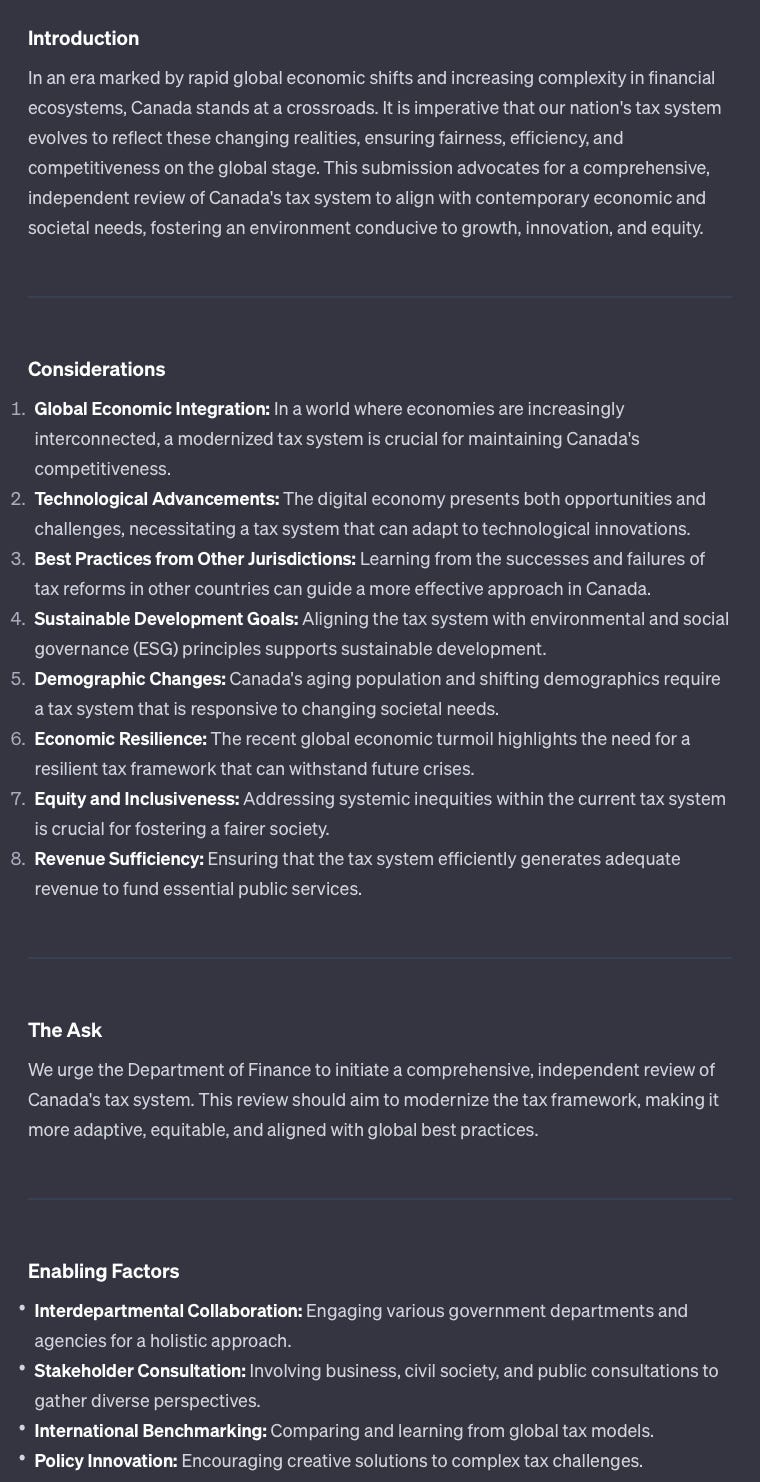
It contained all the sections I asked for, but I wanted something a bit more sophisticated. So I put ChatGPT to work, asking it to show me its thinking for some of the major sections.
Step 2: Dig Deeper
I like using the “Five Why’s” to get ChatGPT to dig deeper. It’s a simple prompt:
Expand on your considerations. For each, answer the basic question, why? And then answer 5 more times to give me an exhaustive explanation.
It did exactly as I asked, and even threaded it for me, which made it easy to follow along:
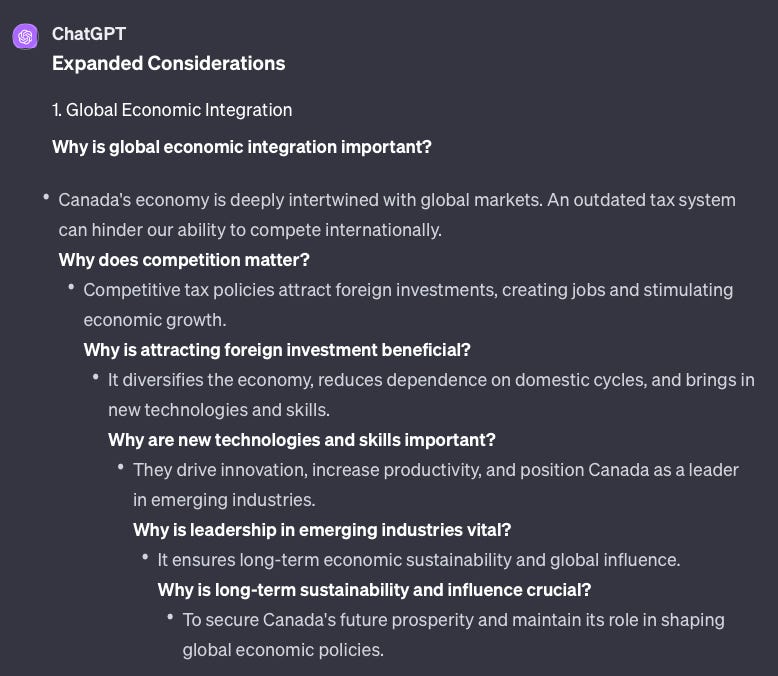
At one point, ChatGPT stopped this task, adding at the end of the message, “[Continued in the following response due to length limitations].” It was stuck, so I simply replied, “please continue” and got the rest of the considerations.
Step 3: Synthesize
Now that I had more substantive content, I wanted to roll this content into a more robust, but synthesized considerations section.
Prompt:
Great. Now, synthesis what you wrote above into a more fulsome considerations section.
ChatGPT didn’t disappoint:
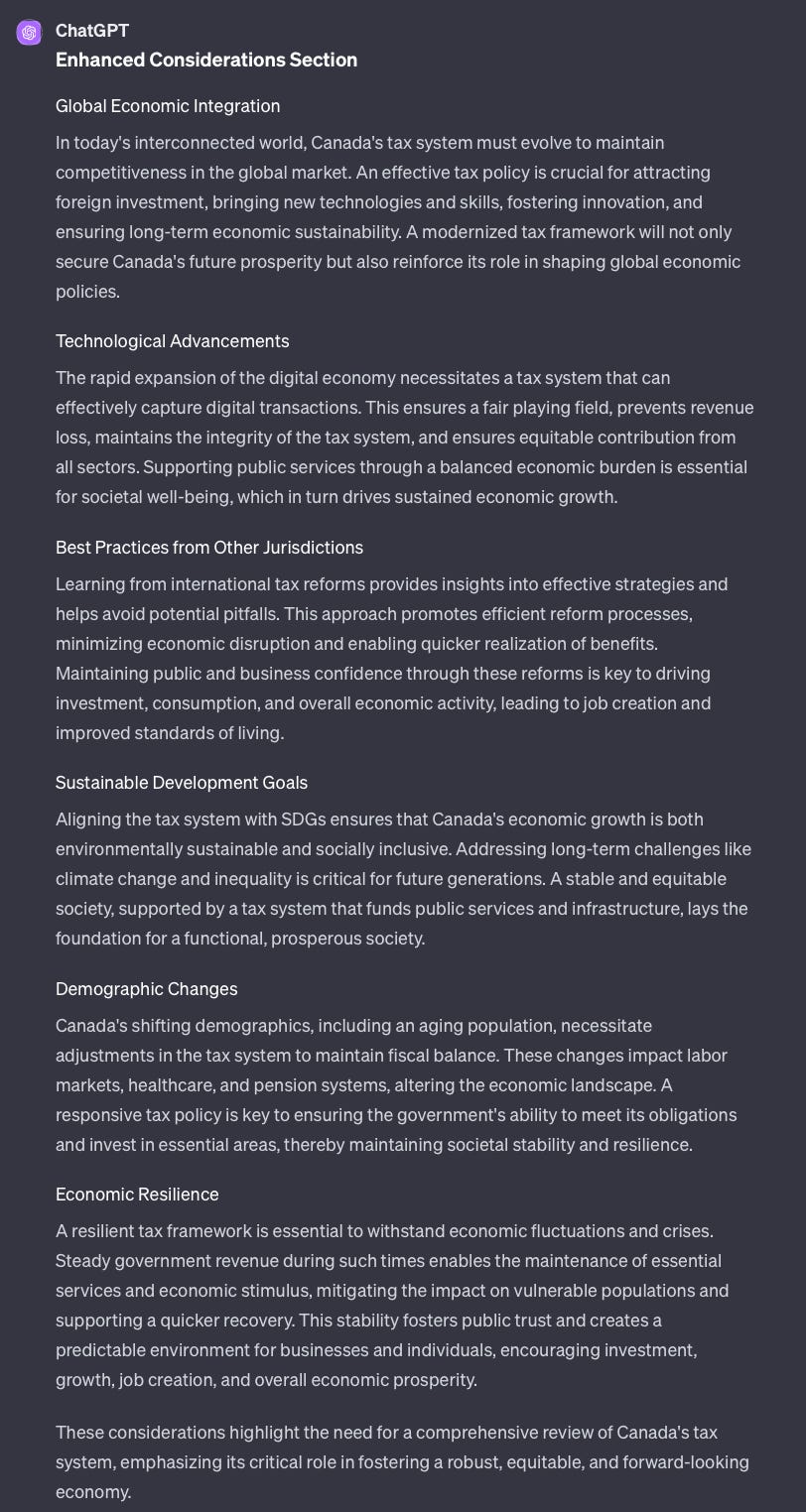
Step 4: Continue to dig deeper and synthesize where needed
I also found the enabling factors section to be basic. I told as much to ChatGPT and asked it to make that section more robust, using this prompt:
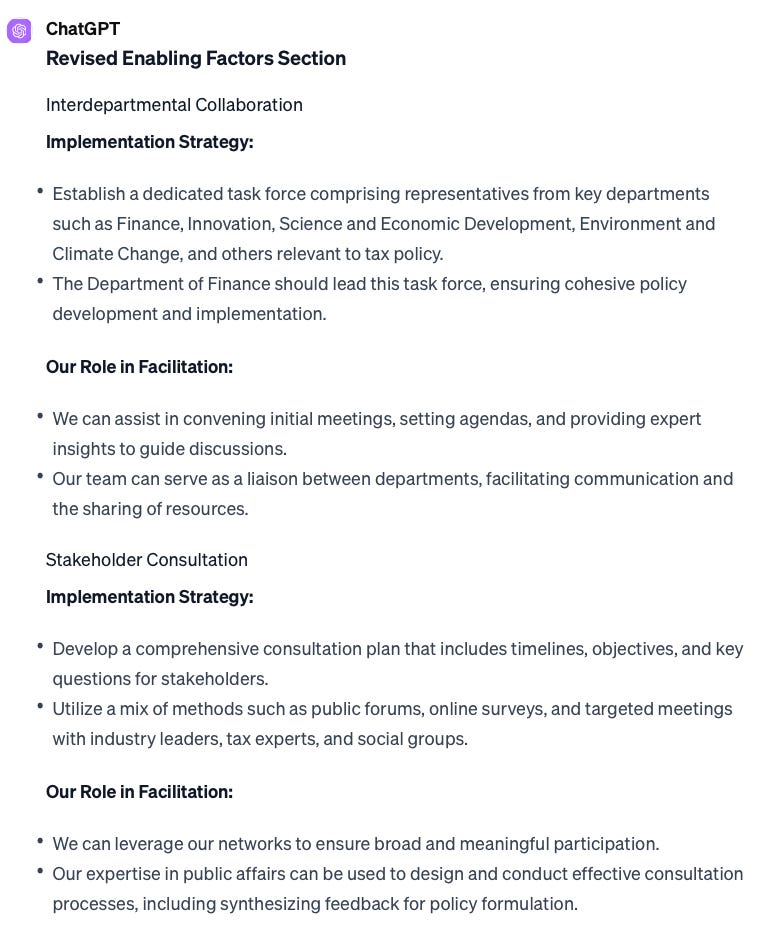
Let's move on to the enabling factors. What you wrote is basic - and advice that a seasoned civil servant would already be familiar with. Please rewrite that section by specifically explaining how to accomplish those enabling factors, the role the department has to play in these and how we can help them.
The output is significantly improved. Here’s a snapshot. You can read the full output in this Google Doc.
I moved on to the stakeholder section with this prompt:
Can you do the same with the stakeholder section? For each stakeholder answer why they are implicated, going three levels deep. Be clear in noting how they are positively or adversely affected.
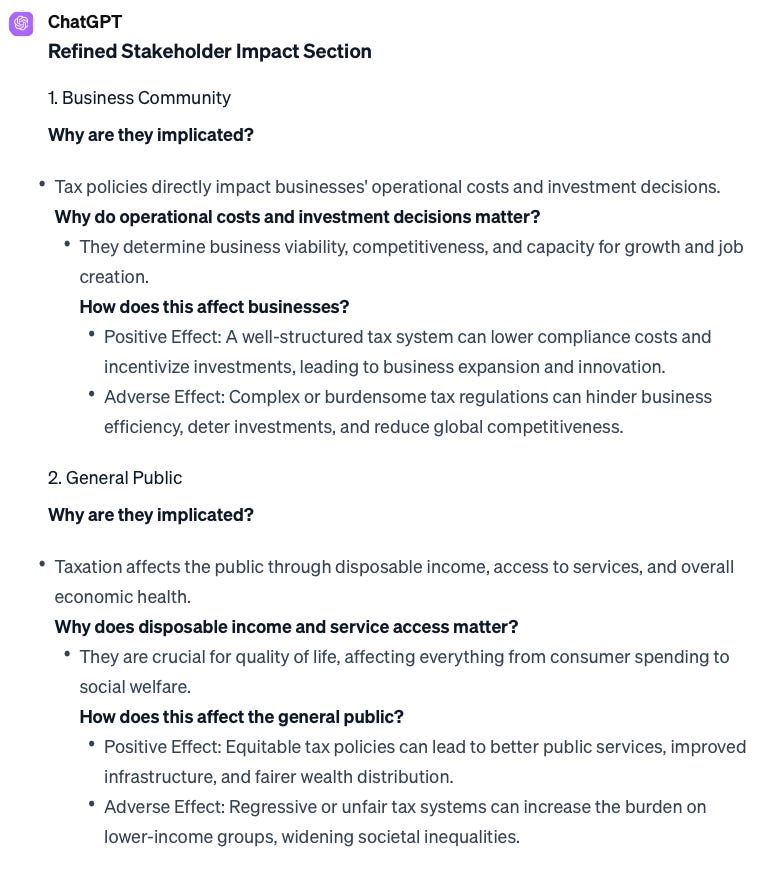
I found the format a bit too tit-for-tat, so I asked ChatGPT to clean it up:
Great, now synthesize this section so that you have a clear paragraph for each stakeholder that captures the points you made.And with that, I have a draft pre-budget submission letter!
Of course, if I had specific data points and policy frameworks in mind, I would have fed these to ChatGPT to make the letter more specific. That’ll be for a different tutorial. Today, our focus is on getting ChatGPT to assist in creating three distinct message tones tailored to different audience segments.
We have the first audience covered, now on to the second.
Audience #2: Industry
Here’s how we can use ChatGPT to adapt our sample pre-budget submission into a high-level policy briefing note in less than 10 minutes.
Note: I’m deliberate in my language here. To produce a truly detailed policy briefing note for a technical audience, you’ll need to conduct your own research, or supply ChatGPT with this research.
For now, the objective of this tutorial is to explore how ChatGPT can adapt your content for different audiences, so we’ll do so at a higher-level. I’ll save a tutorial on how to conduct a detailed policy analysis for another day.
Step 1: Produce a Basic Policy Brief
Let’s get to it with our first prompt:
You are a public policy expert with exceptional skill at explaining a policy concept to an audience of industry stakeholders and academics. You specialize in tax policy and communicate with a technical and data-driven tone. You are not afraid to use technical terms and use evidence-based arguments.

I need your help.

TASK:
I have written a document that will serve as a pre-budget submission for the Department of Finance, with a specific policy ask. I need your help converting this submission into a technical briefing note I can use with industry stakeholders, which are primarily small and medium-sized business owners in Canada. I will also use this briefing note to build a network of supportive academics who specialize in economic and tax policy.

OUTCOME:

Create messages that effectively communicate with industry experts and academics in a language they value, ensuring the content is seen as credible and informative.

STRUCTURE:
1. Executive Summary. This overview should be engaging and help busy readers quickly understand my argument. Keep this to one paragraph.

2. Introduction: set up the rest of the document to clearly convey my argument. In one or two paragraphs, define why I am writing the brief and express the urgeny and importance of the topic to industry stakeholders.

3. Research: This is the most important section because it explains the reasoning beind my policy ask. This section needs to describe the problem that my policy ask intends to solve. In this section, provide a summary of the facts. Present the results in a way that lends them to your analysis, but do not interpret them. The goal is to take the reader on a journey that ends with them seeing the facts from my perspective.

Here are the core facts I want you to use:
- Many of Canada’s international peers have undertaken comprehensive reforms or full-scale reviews of their tax systems
- Canada has yet to join in with a comprehensive review. As a result, there are implications for Canada’s competitiveness.
- From the United States to France, the Netherlands and Japan, many of the world’s developed nations and some of Canada’s biggest trading partners have completed or are pursuing major tax reform initiatives. Countries such as the U.K., New Zealand and Australia have put their tax systems up for full-scale reviews.
- According to Nanos and CPA Canada, Over 81 per cent of Canadians see a comprehensive tax review as a priority for the federal government, with more than one in three (35 per cent) saying it should be a high priority. Almost half (47 per cent) of Canadians say the tax system has become more complex than it was 10 years ago.
4. Analysis: this section should interpret the data in a way that is accessible and clearly connected to my policy ask. Express ideas using active language and strong assertions. The goal is to be convincing while ensuring that the analysis is balanced and defensible.
5. Conclusion. Write a strong concluding paragraph with a call-to-action.

Are you ready to begin? If so, I will share the cover letter for my budget submission.
Being specific about the outcome is an important part of the prompt. In my original testing, I hadn’t included this and the result was just a summary of the budget submission document.
Just as important? Providing ChatGPT with the facts you want highlighted in the research section. On its own, it failed to find anything useful, often resorting to explaining what I should do to conduct this research.
Feed ChatGPT your own research and data, and you’ll get better quality output.
Step 2: Contextualize for stakeholders
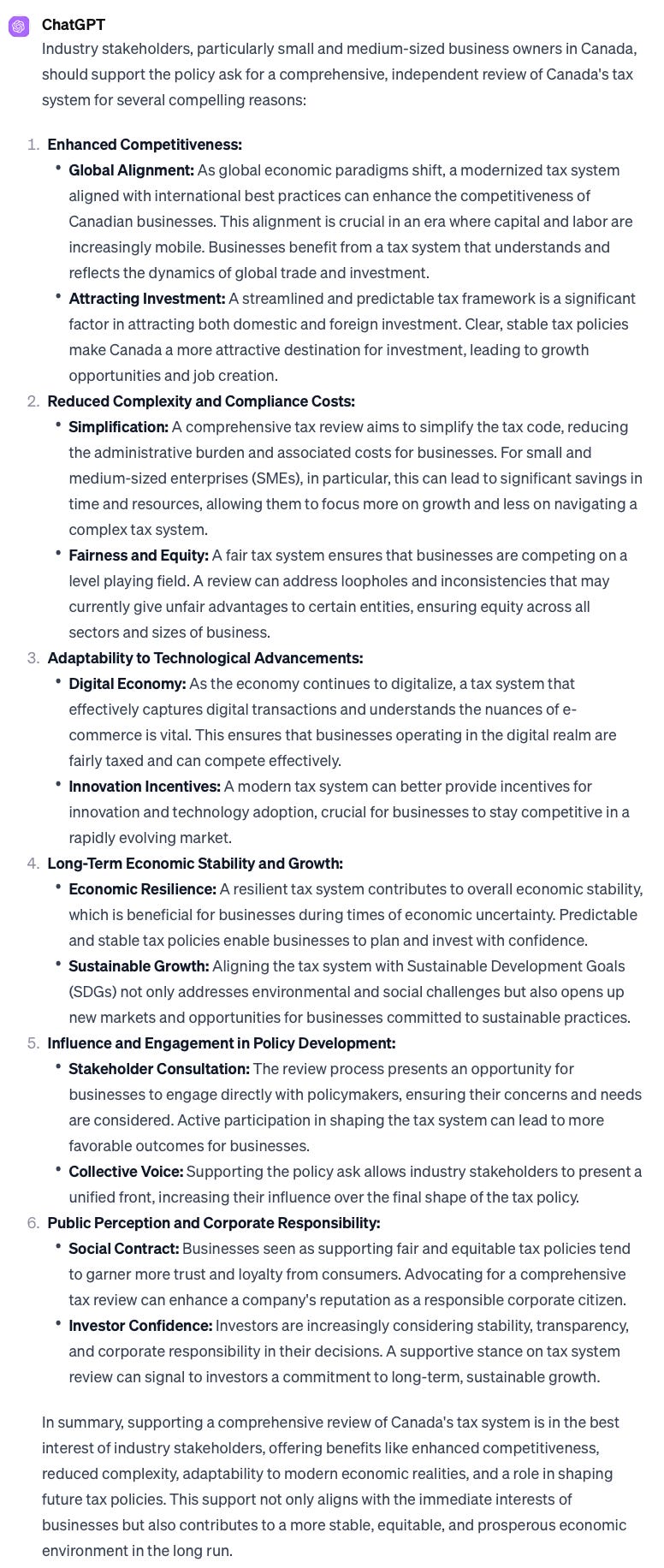
Next, I wanted to see if ChatGPT could contextualize this briefing note for one of the key audiences I had in mind: industry stakeholders, and academics.
Why should industry stakeholders support this policy ask? Give me a detailed and thoughtful answer.
Step 3: Write a stakeholder outreach email
Now that I had this all spelled out, I decided to put this to practical use: an email outreach script.
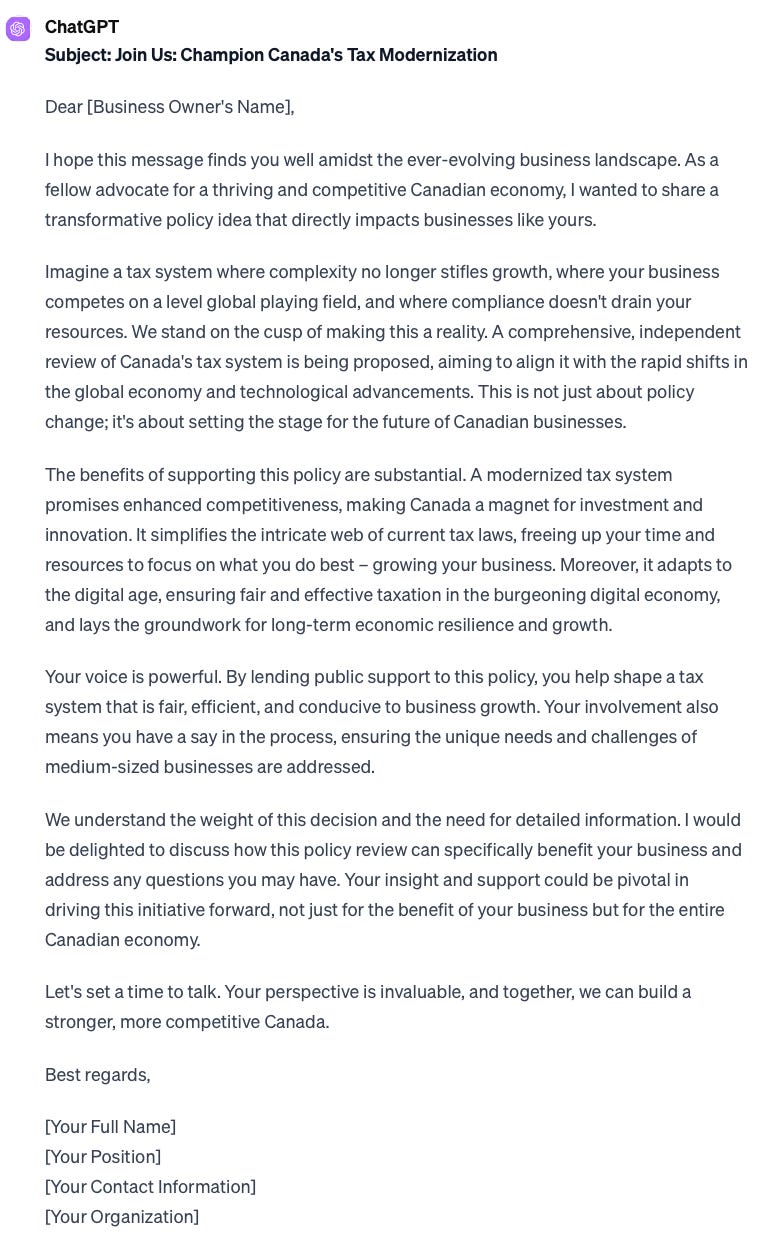
Great. Now use this to write a compelling email to a medium-sized business owner in Canada to share this policy idea with them and encourage them to lend us their public support for the idea.

Please use the AIDA copywriting framework, but do not include the headings of the framework.
Ensure the email subject is 7 words or less. Avoid clichés.
Not bad. I’d edit this some more — it’s a bit too salesy for my liking, but as a first draft, it gives me something solid to work from:
Of course, you could use a different copywriting framework, or provide a specific outline you want ChatGPT to follow, but as you can see, its ability to apply what it learned in the previous steps is very good.
Let’s move on to our third and final audience.
Audience #3: General Public
By now, we’ve spent considerable time in the weeds with very technical language. Making the case for a revamped tax system with the general public requires a conversational and relatable tone. This involves using simple language, and a friendly approach.
Step 1: Twitter thread
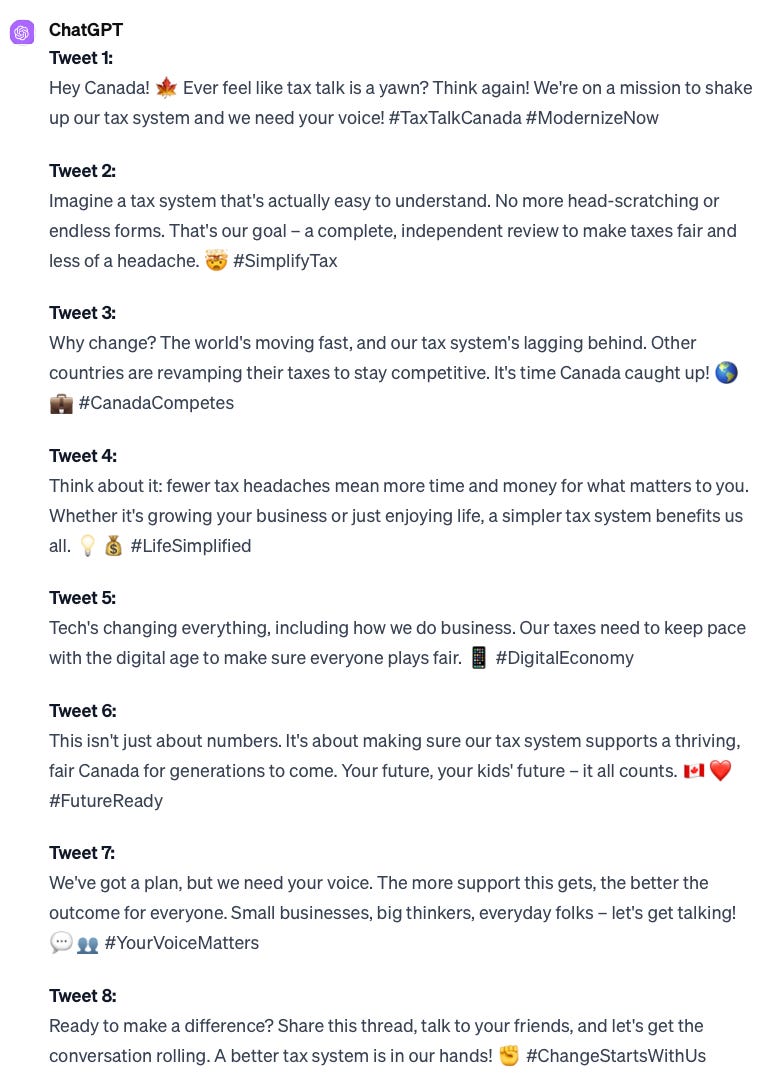
Let’s start with a Twitter thread. The format should lend itself well to a policy note. It lets us break it down into micro sections and forces us to be very clear with the character limits. In turn, this serves as a strong foundation for spin-off content.
Let's move on to the next task. Now you're a seasoned communicator, specializing in taking complex policy ideas and making them relatable to the general public. You write in a conversational  and relatable tone. You use simple language and a friendly approach.

Your task: convert the budget submission letter, as well as what you know from the policy brief produced above, to write a Twitter thread. Make sure the first tweet in the thread is compelling, giving the audience a strong itch to read on.
This is where ChatGPT really shines:
How about Instagram?
I also need to produce 3 interesting Instagram Reels. What do you suggest?
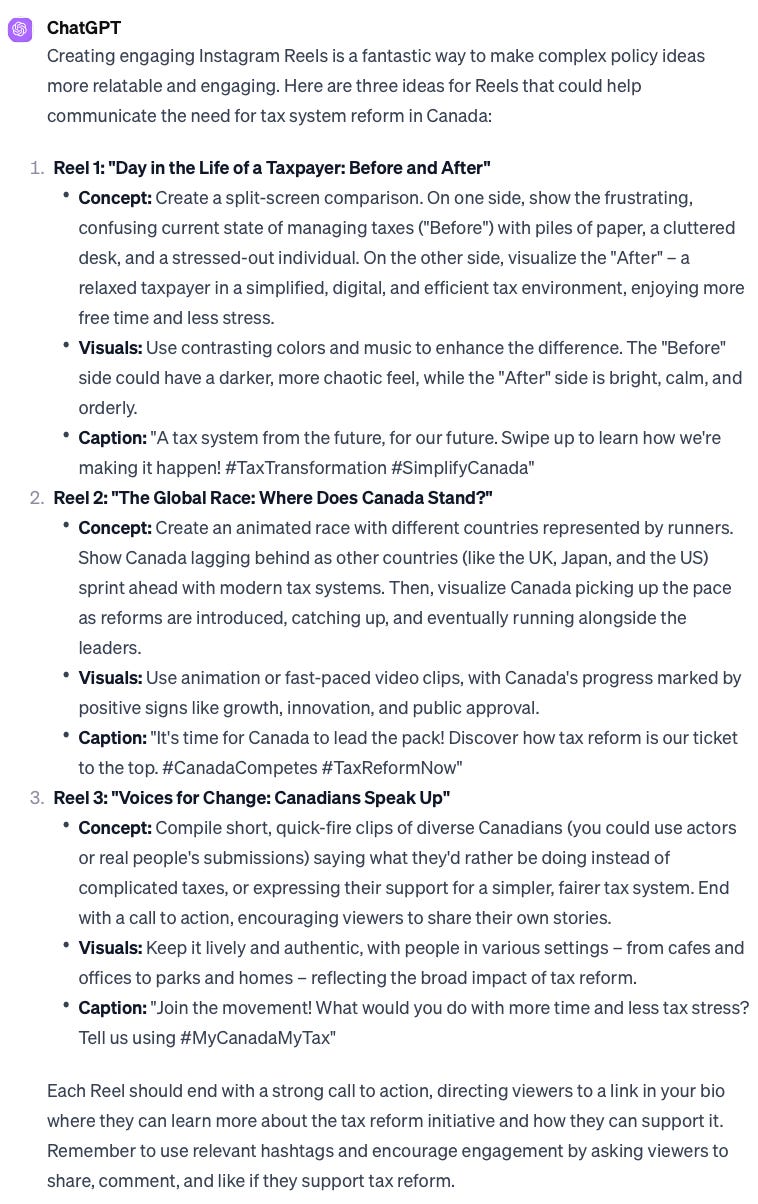
In the Google Doc containing all my outputs, you’ll also find a YouTube script for a 2-minute YouTube video. It took me 5 minutes to get these scripts out of ChatGPT.
And there you have it!
1 policy idea
1 pre-budget submission cover letter
1 policy brief
1 stakeholder outreach email
1 Twitter thread
3 Instagram Reels scripts
1 YouTube script.
All in less than 25 minutes
PS… If you’re enjoying Influence With AI, will you take 7 seconds and forward this edition to a friend? It goes a long way in helping me grow the newsletter and helping more people turbocharge their public affairs careers.
I’d love your input on how to make Influence With AI even more useful for you! So please leave a comment with:
Ideas you’d like covered in future editions
Your biggest takeaway from this edition
I read & reply to every single one of them!