


I’m excited to share today’s tutorial with you, because the results blow my mind every time.
Here’s what we’re going to cover today:
We’ll outline a public engagement and community issue we’re dealing with to ChatGPT, which will then ask us clarifying questions to build out an initial stakeholder list.
We then get ChatGPT to dig deeper, outlining how each stakeholder group is impacted.
From there, ChatGPT will map our stakeholders on the Power/Interest Stakeholder Grid.
Once the stakeholders have been categorized, ChatGPT will produce an engagement plan.
Then we’ll have ChatGPT produce a detailed tactical plan to enable the engagement plan.
You can see the final output here.
Let’s get started!
Step 1: Set the stage for the task
As usual, I begin by defining a specific role, providing a detailed outline of what I need ChatGPT to do:
Prompt:
Your role is to act as a seasoned public affairs expert with exceptional skills in policy analysis, stakeholder mapping and public engagement.

These are the steps we'll follow. Please confirm that you understand these steps before we proceed:

1. You will ask me to outline the situation for which I need to conduct a stakeholder analysis. Once I provide you with the situation, please ask me follow-up questions that may help you fully understand the situation, my objectives, and how I define a win.

2. Then, you will provide your initial list of stakeholders that are impacted by this situation, can influence it, or can be impacted by it directly or indirectly.  Please ask me any follow-up questions that will help you build a robust list.

3. Ask me to confirm that the list is sufficient before moving to this next step: For each stakeholder, identify their needs,  concerns, motivations, and interests as they relate to the situation and to each other. For example, if you list "businesses" as a stakeholder, you might note that they may support a new infrastructure due to economic benefits.

4. For each group, provide me with fresh ideas on how I could engage them. What should my core message to them be? Which platforms should I use to reach them? How do I motivate them to support my effort and become champions of my cause?

Are you ready to proceed?
Here’s what’s going on:
We want ChatGPT to give us a robust strategy, so we’re forcing it to ask us clarifying questions first. The result is that we’ll have some work to do early on to guide ChatGPT, but this effort will pay off. Get ready to roll up your sleeves. Your intern is going to ask you a lot of questions, but the end product will be worth it.
From there, you need to outline your specific situation. The more detail you provide, the higher quality work you’ll get from ChatGPT in the following steps.
To illustrate, I used a the following hypothetical scenario:
Step 2: Outline your specific situation
Prompt:
Situation: I work at the City of Surrey and we have been approached by a local soccer club to lease them land owned by the City, to construct a new indoor soccer facility. The club is prepared to pay the full $5 million construction costs of the building, so city taxpayers will not be out of pocket. However, I'm concerned that this good news story will be met with resistance, and I need to map out who will be supportive of this project, and who might be opposed, as well as the influencers that might help us communicate the benefits of this project.

As I see it, the project has several benefits to the community, including fostering active play during cold winter months. But I'm also concerned about the optics of a local club charging its own fees for a building that sits on city land.
Here’s a templated version you could fill in to help you with your own analysis:
Prompt:
Situation: I work at [organization] and we [have this specific challenge that involves specific stakeholders]. I'm concerned that this [good/bad situation] will [meet this specific obstacle or challenge]. I need to map out who will be supportive of this [project/bill/debate/plan] and who might be opposed, as well as the influencers that might help us communicate the benefits of this [project/bill/debate/plan].

As I see it, the [project/bill/debate/plan] has several benefits to [specific stakeholders you think may be onside and why]. But I'm also concerned about [specific roadblock/challenges/problems].
Step 3: Answer ChatGPT’s questions
Get ready, you’re going to need to provide detailed answers to some very good questions! Here’s what I got with my example:
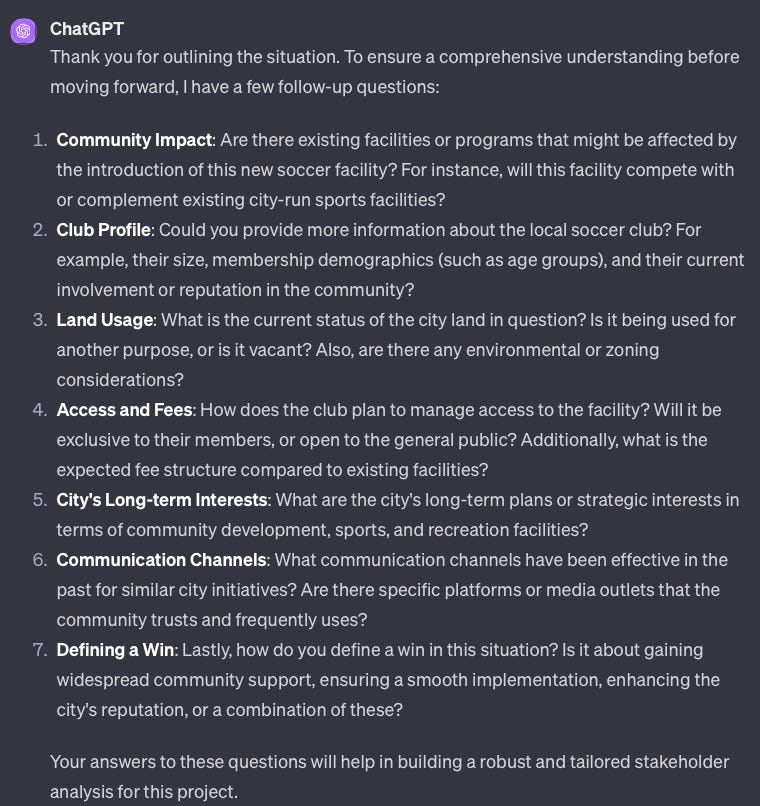
Obviously, you’ll need to calibrate your response to your specific scenario, so I won’t provide a template or prompt for you to copy or follow. You’ll need to do that work. But I recommend answering every question in as much detail as you can.
For my scenario, here is how I replied:
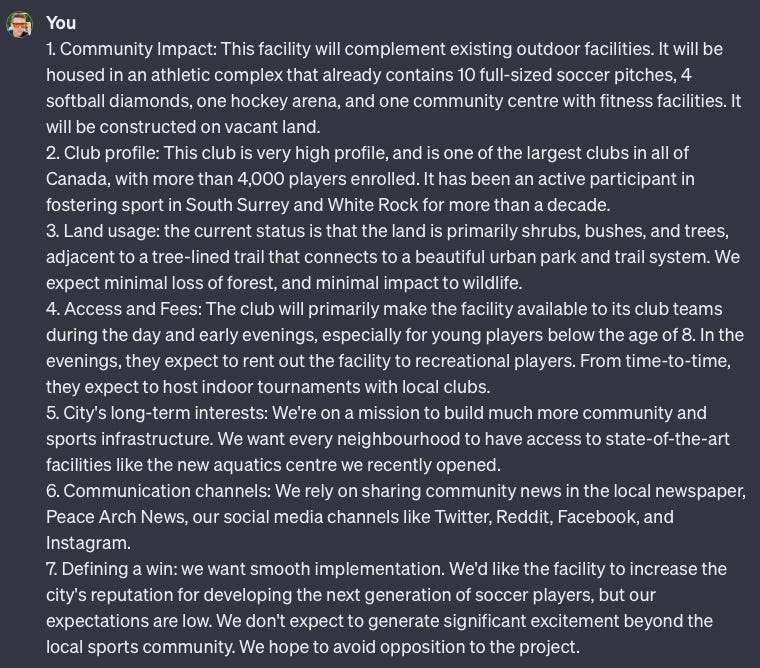
Upon answering these questions, ChatGPT provided me with an initial list of 10 stakeholders.
Step 4: Expand the initial stakeholder list
Once you work with ChatGPT to add or remove stakeholders from your list, you’ll want it to provide more colour and context:
Prompt:
These categories are great. I would also add neighbouring community clubs and local governments who may feel like we gave this club a special deal. They may wonder why they're not getting an indoor facility.

For each of these categories, can you provide me with specific examples?
I’ll spare you a wall of screenshots, but as you can see in the output file, the initial stakeholder list was more robust.
Step 4: Draft Engagement Plan
Once I confirmed to ChatGPT that I was happy with the detailed list and its identification of interests and concerns for each group, it turned its attention to developing engagement strategies for each group. Here’s a snapshot:
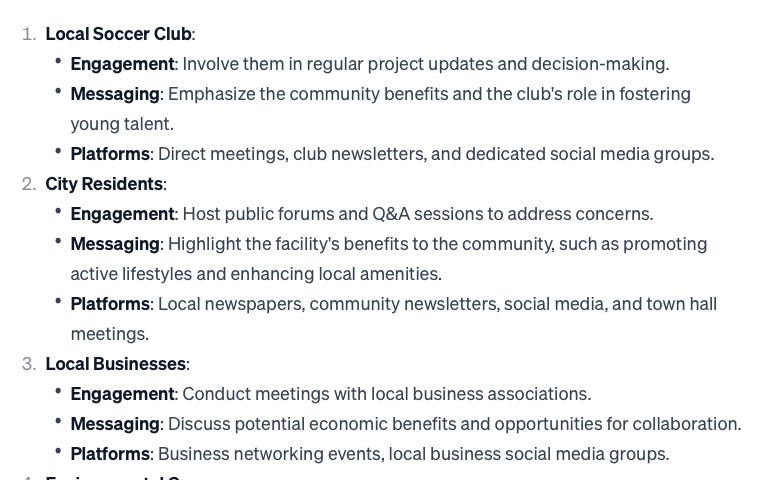
This is a strong start, but the real work comes in mapping these stakeholders. Can ChatGPT do this analysis without timing out? Yes, it can.
Step 5: Map Stakeholders to Priority/Influence Grid
I uploaded this visual of the Stakeholder Grid with this prompt:
Attachment:

Prompt:
Let's move on to the next step: prioritize these stakeholders by assessing their level of influence and level of interest. I would like to place them in the stakeholder grid, which I have attached. Before we proceed, can you confirm that you understand how the stakeholder grid works?
If you've never seen this grid before, no stress. I’ll let ChatGPT explain it:
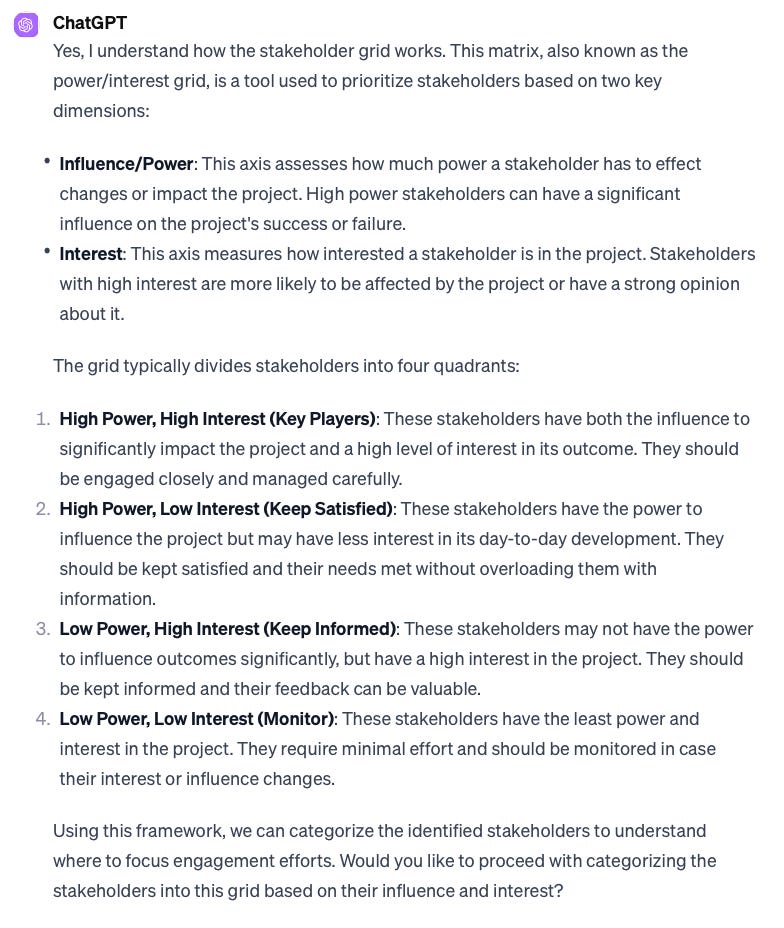
We don’t simply say “yes”. If we do, we might get bland answers. Instead, we say this:
Prompt:
Yes. Please ask me clarifying questions to help you do this categorizing.
Here are the types of questions I got:
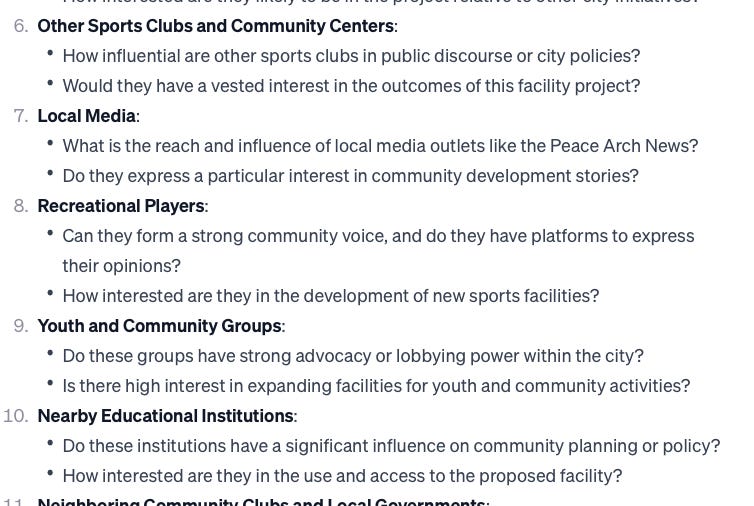
Again, I provided detailed answers to each, to which ChatGPT responded. You can see the detailed response in the output document, but here’s a snapshot:
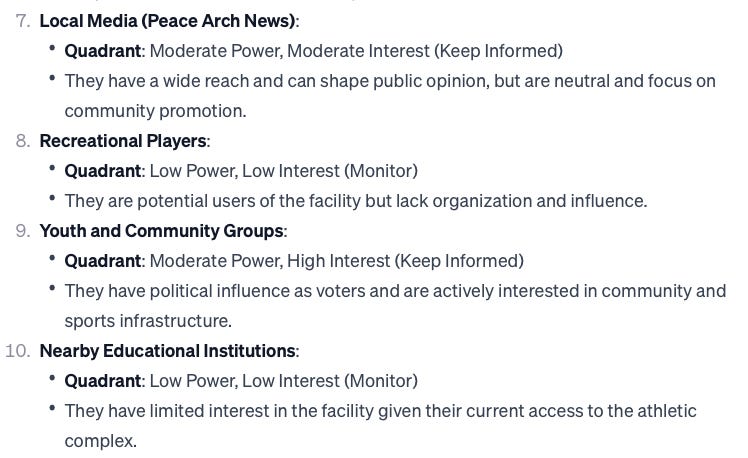
I found it difficult to follow in this format, so I asked ChatGPT to place in a table for me:
Prompt:
Can you place these in a grid or a table for ease of viewing
Much better!
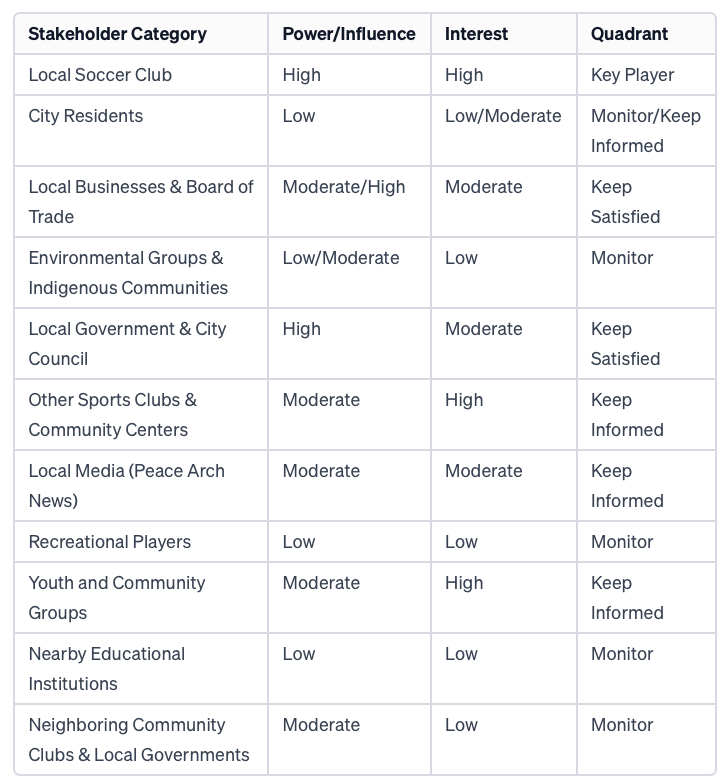
When I confirmed that this works for me, ChatGPT offered to help me develop engagement plans, craft messages, and other strategic communications. I took it up on that offer:
Step 6: Produce a Detailed Engagement Plan
Prompt:
Yes, the final step is to create a detailed engagement plan.  Please write the first draft of this plan taking into account the following considerations for each stakeholder group:

1. Objectives for engaging the stakeholder.
2. Key Messages to communicate to each group
3. Engagement Channels
4. Timing and Sequence
5. Potential Concerns and Objections that might arise from that group and how these concerns can be addressed proactively.
6.  Identify opportunities for stakeholders to collaborate or participate actively in the project.
7. Provide a resourcing estimate (staff, budget, time) to engage each group
8.  Advice on how to take, collect, and analyze the feedback we get from that group
9. Success metrics - how do we know we're on the right track with that group?
10. Risks associated with each group and how to mitigate
You’ll find the full output in the detailed output file.
Step 7 : Tactical Plan
This is great. Let's work on the tactical implementation now.  We'll work through this one stakeholder at a time so that you don't get overwhelmed.

Let's start with 1. Local Soccer Club.

Can you break down your proposed engagement plan into smaller steps? Summarize them in a to-do list
Rinse and repeat, until you get through each stakeholder and you have yourself a robust stakeholder map, engagement plan, and steps to execute that plan.
That’s it!
I hope you enjoyed this guide. Let me know what you think in the comments!
Chat soon,
Joseph