


We’re taking a break from AI platforms this week and going analog. Think, whiteboards, sticky notes, sharpie pens, and healthy in-person discussions. Why? So that we can unleash AI in the right places.
One of the big challenges we’re all facing in our work is assessing where and when we can or should use AI. The opportunities are endless:
Find efficiencies — offload low-value tasks so we can focus on strategic decision-making..
Analyze complex information quickly — make sense of big data without needing a degree in data science.
Help us think through complex problems and unleash creative thinking.
But the risks are also high:
AI dependency — turning to AI as a crutch.
Loss of knowledge — allowing our critical thinking to atrophy.
Factual errors — failing to conduct quality control on AI’s work.
Ethical concerns — deploying AI without considering the ethical implications and potential biases.
Security risks — overlooking the vulnerabilities that AI could introduce into our systems.
Job displacement — reliance on AI could potentially lead to job loss.
Every organization has its own needs and risk thresholds. Identifying where your organization’s risk tolerance lies, and where your team sees an acute need to deploy AI in its day-to-day work is mission critical in 2024. Failure to do so could result in your team using AI in ways you’re not prepared for. So today, I’ve designed a simple 2.5-hour workshop you can customize and use to surface these opportunities and risks in your organization.
Let’s get into it!
Part One: Workflow Analysis
🕰️ Time: 60 minutes
You’ll begin with a journey mapping exercise.
In advance of the workshop, think about the big deliverables or areas of focus that consume your team’s time on a recurring basis. Maybe it’s your sales cycle. Or writing the annual report. Or organizing a Fly-In/Lobby Day.
Once you have identified what you want your team to focus on during the workshop, identify two major points in your organization’s workflow in delivering on your selected area of focus.
For example, if you choose to focus on a Lobby Day, your two points could be:
Point 1 = Assessing the need for a Lobby Day in the capital.
Point 2 = Completing a Lobby Day in the capital.
Write each of these points onto its own sticky note and place them on a wall. Do this in advance of the workshop and you’re ready to begin the journey mapping exercise with your team.
🤒 Exercise: Identify pain points (20 minutes)
Ask the group to map out their current tasks and identify pain points or inefficiencies associated with each task along the continuum between the two points you’ve identified above.
Each item gets put on its own sticky note, and placed along the continuum before, between, or after the two points. Encourage the team to identify pain points associated with each task. Not every task will have a pain point associated with it, and that’s okay. In my experience, 80-90% of the tasks will have noteable pain points.
🤔 Exercise: Reframe pain points (40 minutes)
By now, you have a clear view of the workflow. It doesn’t need to be perfect — you’re not conducting a business analysis workshop; you’re more interested in surfacing the pain points and eventually exploring ways in which AI could relieve those pain points.
Each pain point on the wall is likely framed as a problem statement. “Vendors are unreliable,” “Finding a venue takes too much time…” etc. Your job as moderator, is to work with the group to reframe each of these problem statements into “How Might We?” questions. For each problem on the wall, rephrase the problem onto a fresh sticky note so that it asks for a solution.
For example:
Problem: Finding a venue takes too much time.
Question: How might we build a reliable roster of venues we can come back to easily?
Note: At this point, we’re not focused on finding the AI opportunity. This comes later.
Part Two: Theme Sort and Prioritize
🕰️ Time: 60 minutes
By now your wall should be filled lots of sticky notes and a wonderful assortment of problem statements that have been reframed as solution-focused questions. If it’s messy, that’s perfectly fine, because you’re going to bring some order to this mess.
🗂️ Exercise: Theme Sort (15 minutes)
Group the “How Might We…” sticky notes by theme. This helps you and the group make sense of a lot of information, and will help you prioritize a problem you’ll work on as a group in the final exercise of the session.
Review each sticky note with the group, each time asking yourself or the group if its related to, or similar to a previous note. Place it near that note, or directly behind it if it’s the same.
When all the notes have been clustered, write a title for each one on a larger or different-colours sticky note. These are your themes.
📍Exercise: Priority Mapping (30 minutes)
You won’t have time in this session to focus on every problem. But take a photo of what your team has put on the wall — it’ll give you a clear set of topics to further explore in the coming weeks and months. For today, you want to unlock some creative ideas by picking one problem to focus on.
Draw two axes on a whiteboard.
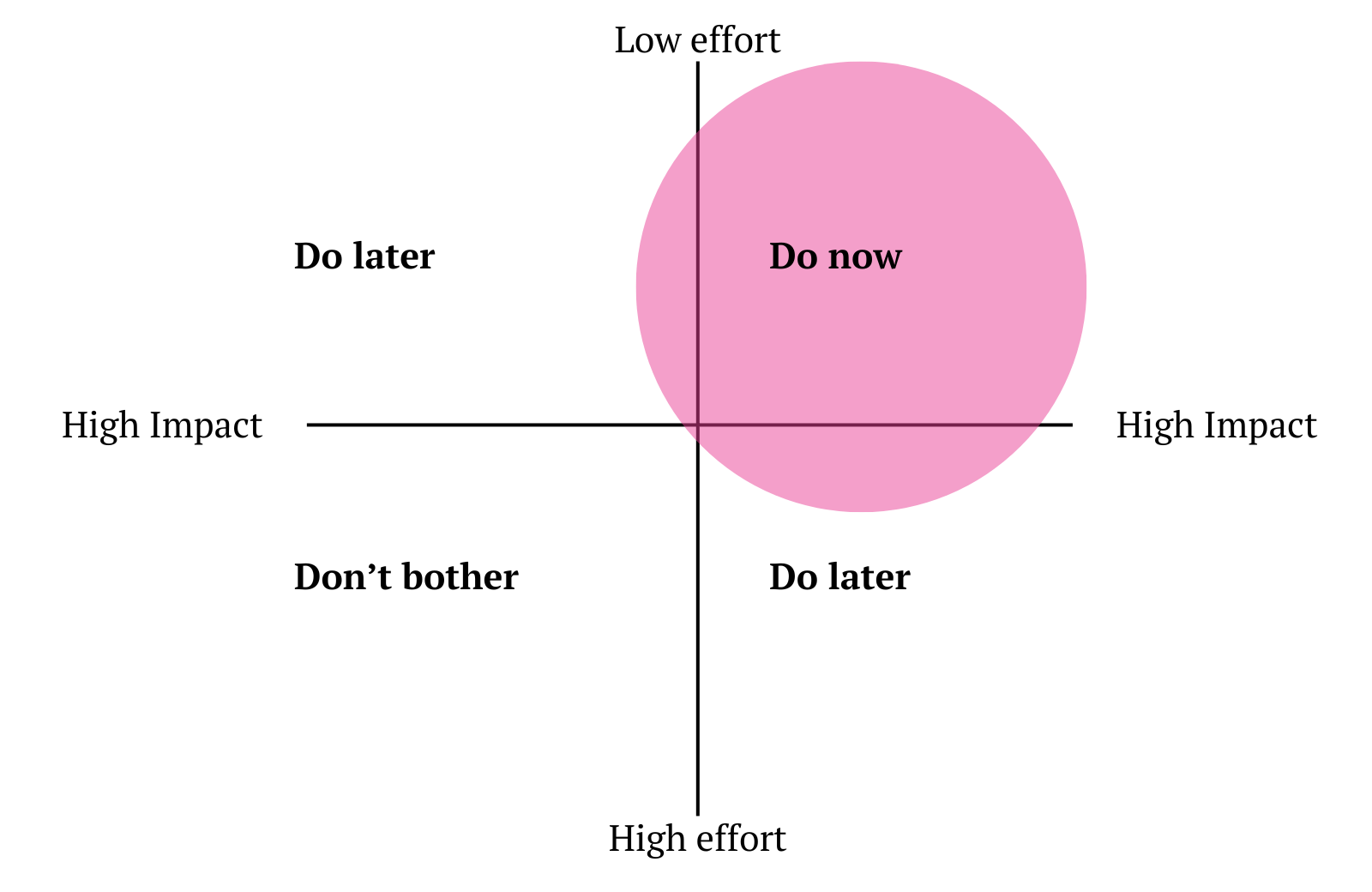
Pick two criteria the group finds important. I find most teams lean into Impact vs Effort or Urgency vs Importance.
Plot your problem statements on the map, ranking each question against the criteria set out on the whiteboard. Don’t get hung up on the debate on whether you’ve placed it in the exact spot — it’s the discussion around each note that matters most.
Look at which notes you have in the top-right quadrant. If you chose Impact vs Effort as your criteria, the notes in this quadrant are low effort and high impact:
🗳️ Exercise: Strategic Voting (10 minutes)
If no clear winner emerges as the problem statement the group wants to focus on in the final part of the workshop, you can use a “strategic voting” exercise to surface the winner.
Give each person 5 votes.
They can place all their votes on one sticky note, or distribute as they see fit across multiple notes. It’s their call how they want to distribute.
Ask the group to vote by placing a check on the post-it note. Remember, if they want to place 3 votes on one sticky note, they can. They’ll then have 2 more votes to mark other notes.
Count the votes and and select the problem statement that came got the most votes.
Write the selected “How Might We” problem in big letters on a whiteboard, but with one big change: insert “AI” into the problem. For example, if the original problem statement read, “How might we build a reliable roster of venues we can come back to easily?”, rewrite it to read, “How might we use AI build a reliable roster of venues we can come back to easily?”
Part Three: Crazy Ideas
🕰️ Time: 30 minutes
To end the workshop, we’re finally going to bring AI into the equation and get the team to unlock their imagination and creativity. This next exercise uses the constraints of time and space to get the team to ideate quickly.
💡Exercise: Crazy Ideas (30 minutes)
Get everyone to take a piece of paper and fold it three times to make a grid of eight boxes.
Review the rephrased problem statement on the whiteboard. This is the question the team will answer with eight crazy ideas.
Let the group know that you’re setting a timer for eight minutes — one minute per box/idea. People can write or draw their ideas. Make it clear that no idea is too crazy. The objective isn’t to surface realistic ideas, but to imagine a better future.
When the timer buzzes, ask each person to talk through their ideas.
Capture these ideas, and facilitate a group discussion.
Your homework will be to evaluate the discussion and these ideas to pinpoint where your team sees a need to apply AI in their current workflows. From there, you can prioritize the appropriate tech stack and policies.
There you have it! If you host a session like this, let me know how it went.