


This week, we take a break from detailed tutorials and get down to basics so that you’re equipped to get the most out of your preferred AI tool, no matter the task.
We’re going to look at prompt writing 101.
By the end of this session, you’ll have a strong understanding of what it takes to write prompts that give you quality output on the first go, with tested prompt frameworks you can come back to often.
Let’s ease into it.
What is prompt engineering?
When we try a prompt, assess its effectiveness, refine it through trial and error until we get effective output.
The prompts I’ve shared in previous tutorials came about through prompt engineering. Pretty much me spending hours rewriting prompts until they gave me what I needed.
I’ve often found that my first attempt at a prompt doesn’t get me what I need. When that happens, there are different ways I can improve the prompt:
Add additional descriptors.
Rephrase
Provide examples
Tell the AI what role I want it playing.
Or just start over.
Prompt engineering matters because if you can master it, you’ll be able to get so much more out of AI in your daily workflow. It’ll feel like you’ve unlocked a super power. Good prompts = good output. Quality in, quality out.
What makes a good prompt?
Good prompts are made of six critical components:
Instruction
Context
Role
Formatting
Tone
Examples
Instruction
Every prompt contains an instruction of some kind:
Explain public affairs to me.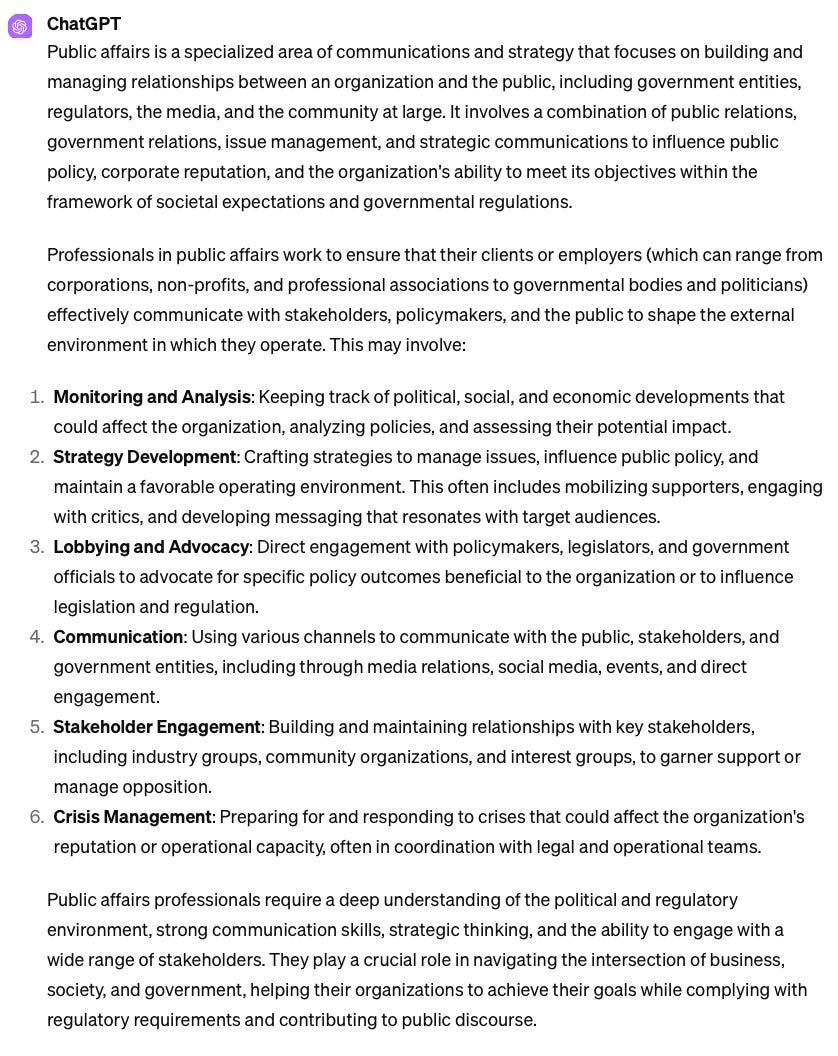
Role
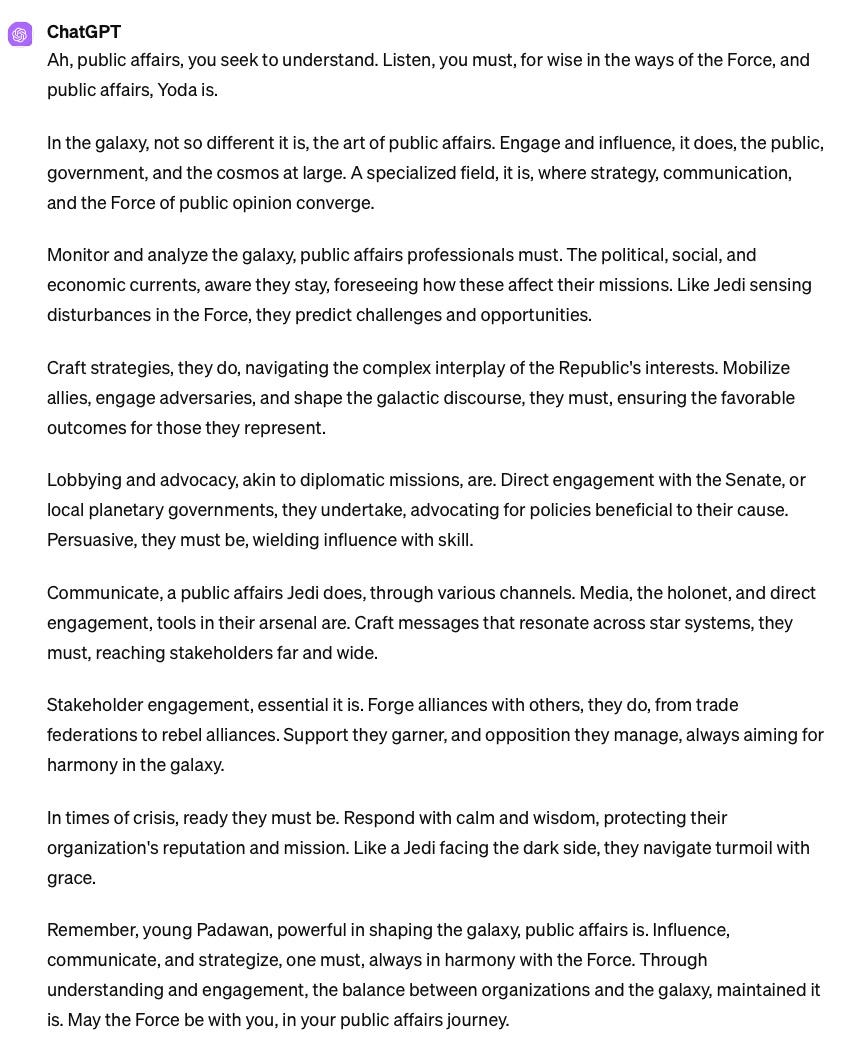
By adding a role, we give the AI an identity that we want it to emulate:
Pretend to be Yoda. Explain public affairs to meAs you can see, this simple change can make a huge difference in the output:
Context
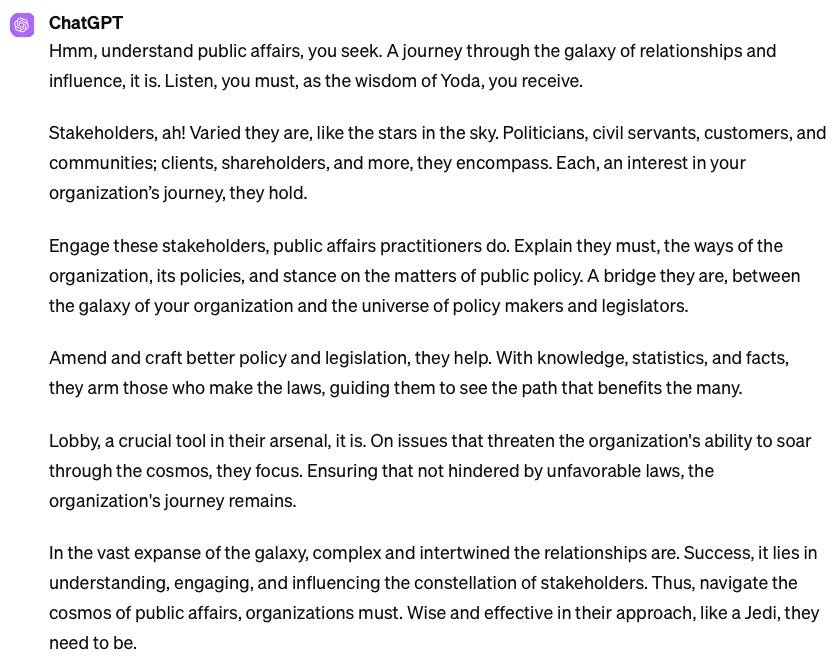
When we enrich the prompt with additional information that we want the AI to consider, we’re adding context. Context can make all the difference and it can take all forms:
Previous material you’ve written
Data
Images
Example:
Public affairs is a term used to describe an organisation’s relationship with stakeholders. These are individuals or groups with an interest in the organisation's affairs, such as politicians (MPs, MSPs, AMs, MLAs, MEPs), civil servants, customers and local communities, clients, shareholders, trade associations, think tanks, business groups, charities, unions and the media.

Public affairs practitioners engage stakeholders in order to explain organisational policies and views on public policy issues, assisting policy makers and legislators in amending or laying down better policy and legislation. They provide statistical and factual information and lobby on issues which could impact upon the organisation's ability to operate successfully.

Pretend to be Yoda. Explain public affairs to me
And again, we get a very different response:
Formatting
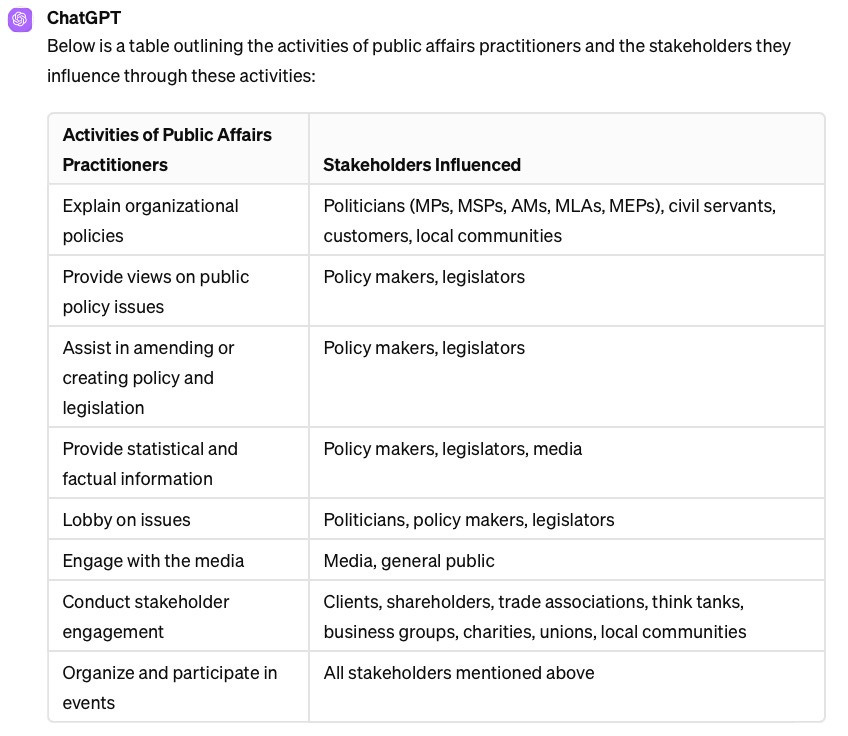
We don’t need to restrict ourselves to pure text output. Sometimes a table, a CSV file, or an image might be more useful. You can control and decide what type of format you get from your AI. In this example, I’ve scrapped the Yoda role-play, kept the context, and asked for a table.
Example:
Public affairs is a term used to describe an organisation’s relationship with stakeholders. These are individuals or groups with an interest in the organisation's affairs, such as politicians (MPs, MSPs, AMs, MLAs, MEPs), civil servants, customers and local communities, clients, shareholders, trade associations, think tanks, business groups, charities, unions and the media.

Public affairs practitioners engage stakeholders in order to explain organisational policies and views on public policy issues, assisting policy makers and legislators in amending or laying down better policy and legislation. They provide statistical and factual information and lobby on issues which could impact upon the organisation's ability to operate successfully.

Make a table of what public affairs practitioners do or make and who they influence with those activities.
Totally different output:
Tone
You can make outputs more interesting by setting the tone. Maybe you want something serious? Calm? Humorous? In the voice of your favourite author? If you provide that guidance, your AI will deliver.
Write me a one paragraph post on why I should hire a lobbyist.
Watch what happens once we ask for a specific tone:
Write me a one paragraph post on why I should hire a lobbyist. Have a sarcastic and humorous tone.
Examples
Sometimes it can be tough to describe exactly what you want. Rather than figure it out, you can provide an example for your AI to follow.
For example, you may want to show your AI how to write like you:
Here are some recent examples of LinkedIn posts I have written about public affairs. Please review and then write me a new post about why public affairs is an important industry, using my writing style.

========

[paste examples here]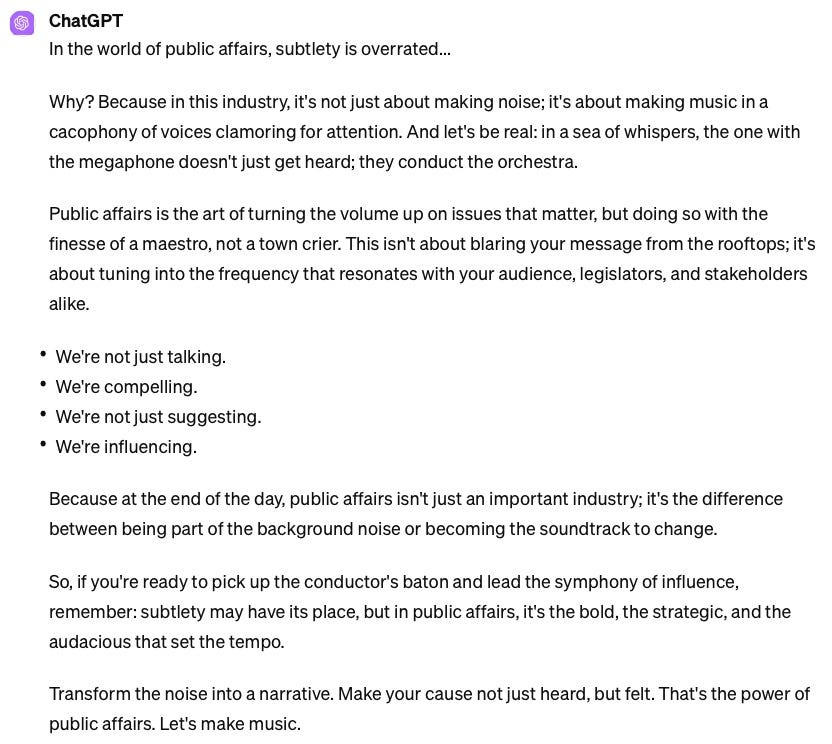
Limitations
When writing prompts, keep in mind these limitations:
ChatGPT 3.5 can only read about 3,000 words at a time, so you can’t overdo it.
AI models are not so good at understanding what you want. You need to provide clear instructions.
And yes, AI models will make up answers when they don’t know what you want — what are known as hallucinations. And they can be tough to spot because they are often delivered with great confidence. So always fact-check the output!
Advanced Strategies
Now that we have the basics down, let’s get more sophisticated with three common strategies:
Zero-Shot Chain of Thought Prompting
Few Shot Prompting
Generated Knowledge Prompting
Zero-Shot Chain of Thought
After your prompt, add the words, “let’s go step by step.” This encourages the AI to offer its reasoning. This method came about when these large language models struggled with simple math problems. Forcing the model to break down the math problem into steps improved accuracy. In our line of work, we want accuracy, always. So let’s set ourselves up for success from the start.
When should you use this method?
When you don’t have many examples to use in the prompt.
Example:
I need to write a technical briefing note on why the Canadian federal government should reduce the GST. Let's go step by step.
Here’s a snapshot of part of the response:
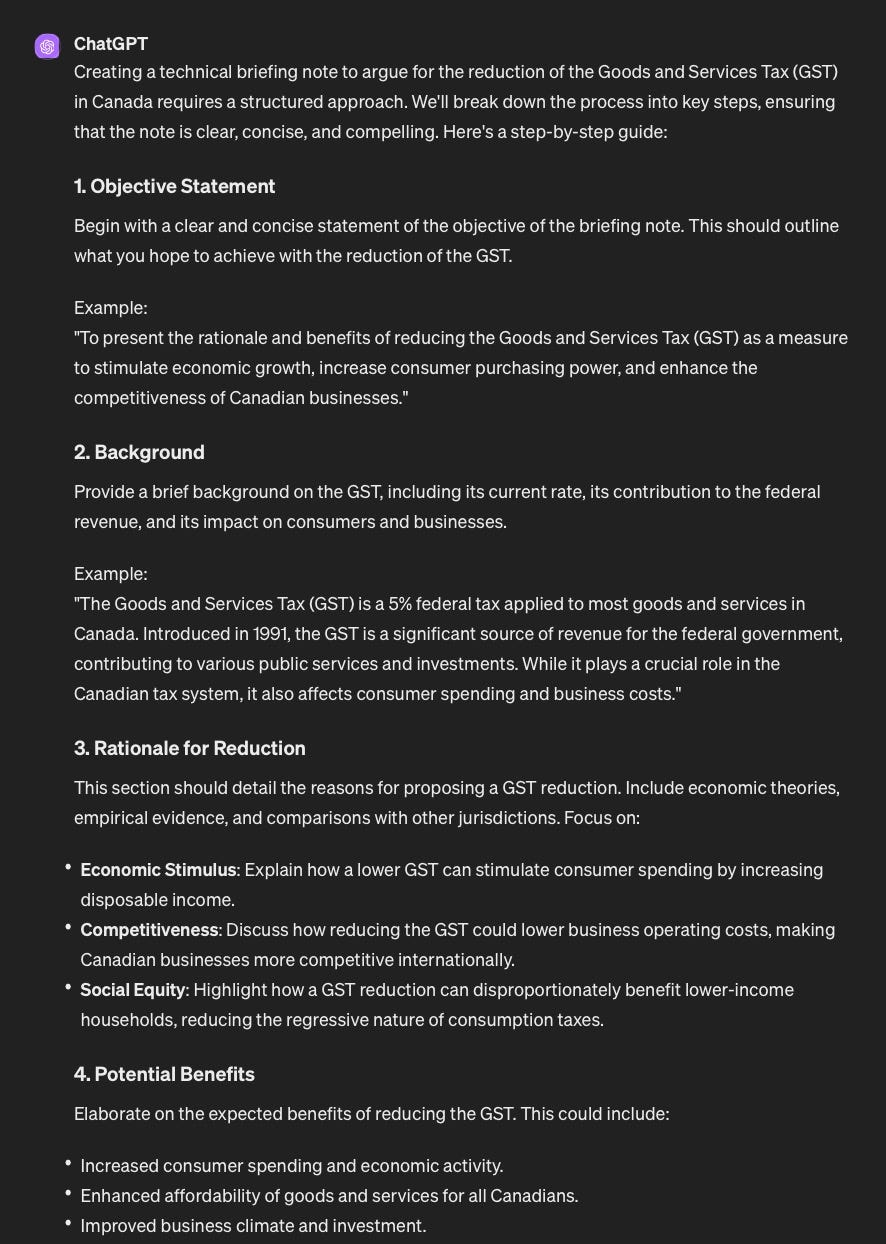
I now have an example template to fill in, or I could take it a step further and ask ChatGPT to write me the first draft using this structure. You can see the full response here: https://chat.openai.com/share/dbd5f079-edb2-41a6-9205-08109fa014c6
Few Shot Prompting
With this approach, we share examples, or “shots” with the AI model so that it knows what we’re looking for. The better and more well-structured your example, the better it will perform.
It’s called “Few Shot” because we’re providing an example, which is different than the “Zero Shot” approach, in which you don’t provide an example.
Few-shot prompting has many applications in public affairs, including:
Natural Language Understanding: think sentiment analysis.
Question Answering: useful when generating Q/A docs to support your comms efforts
Summarization: when you want complex documents summarized in a concise and compelling way.
To use this method, you’ll need to follow these steps:
Gather examples of your desired output
Write a prompt instructing your AI on what to do with these examples.
Run the prompt. Edit as needed.
When should you use this method?
When you have examples to include in the prompt.
Example:
This is awesome! // Positive
This is bad! // Negative
Wow that announcement was rad! // Positive
What a horrible idea! //
Generated Knowledge
This is one of my favourite tactics for getting quality answers from ChatGPT. With this type of prompt, we ask the AI model to educate us, or generate useful information about a topic or question before asking for a final response.
This method works because it helps the model pull information from its memory before answering.
When should you use this method?
When you need common sense reasoning
Example
If I wanted ChatGPT to write me a 5-point plan to “make politicians more likeable” I get this:
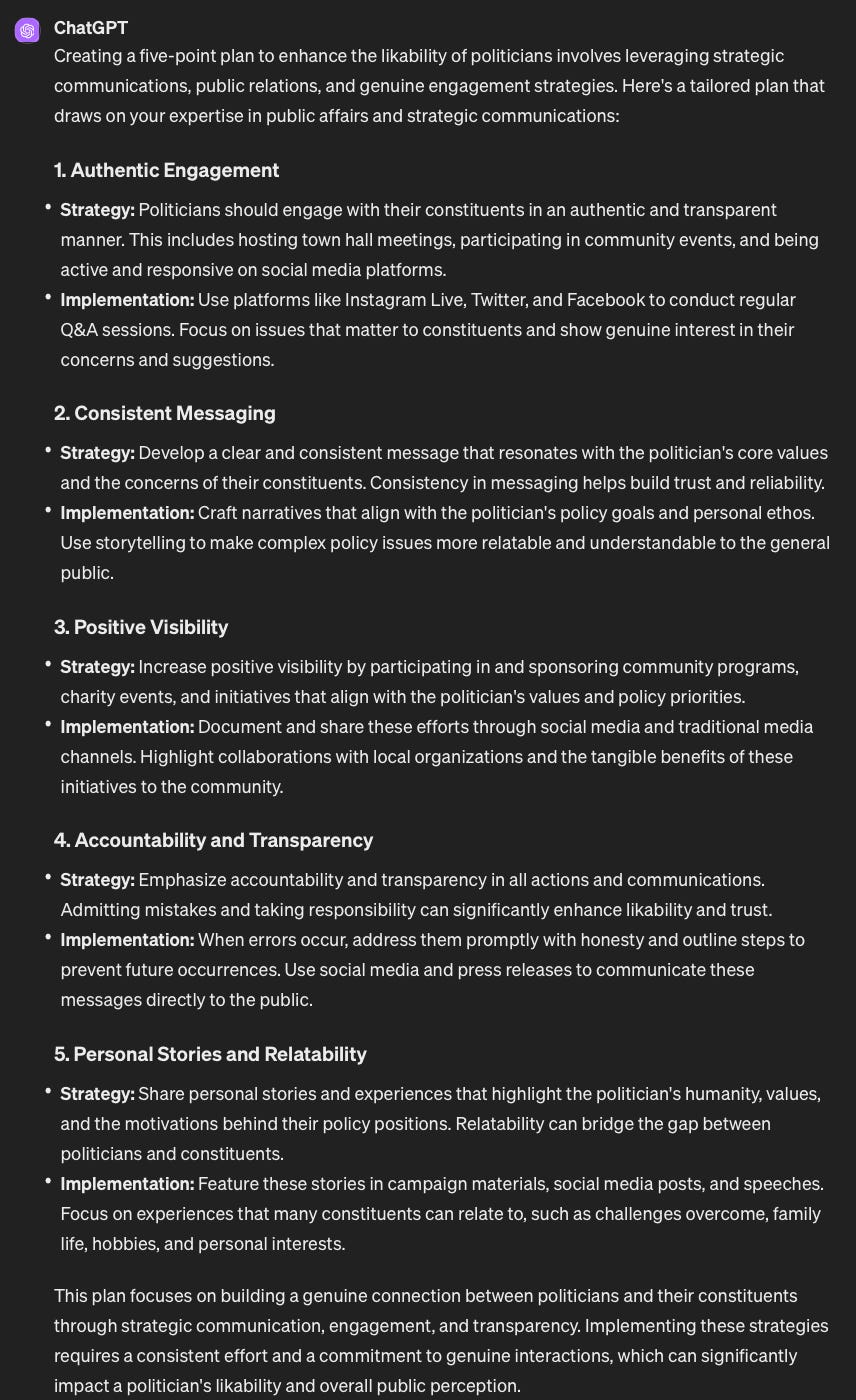
Look at the difference when I ask it for some knowledge:
Why are politicians often disliked? Don't answer the question. Give me 10 facts .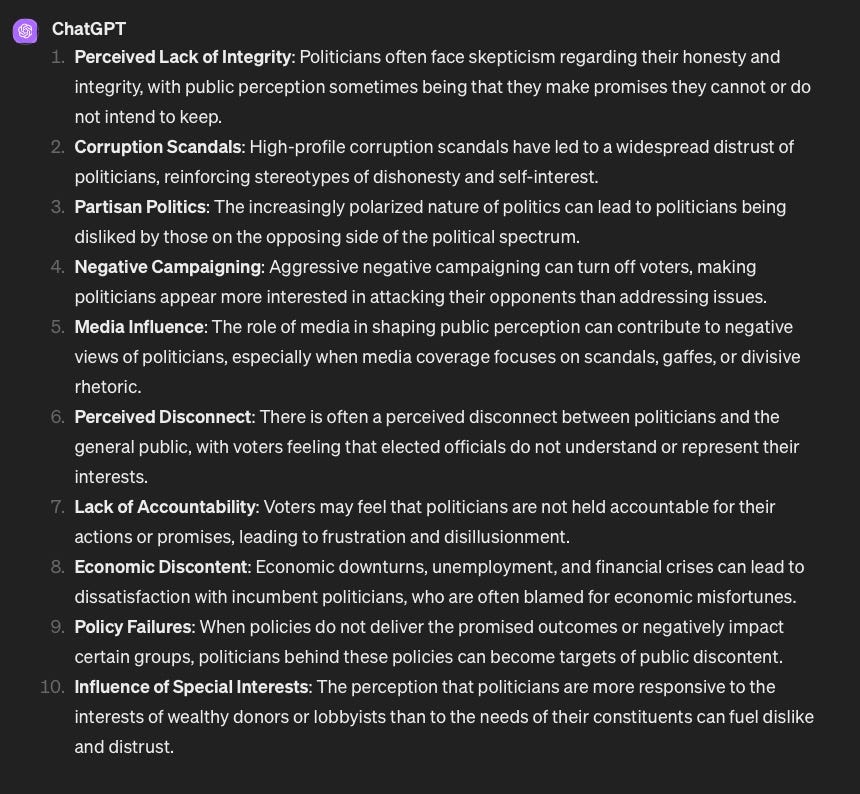
Then:
Can you please write me a 5-point plan to make politicians more likeable?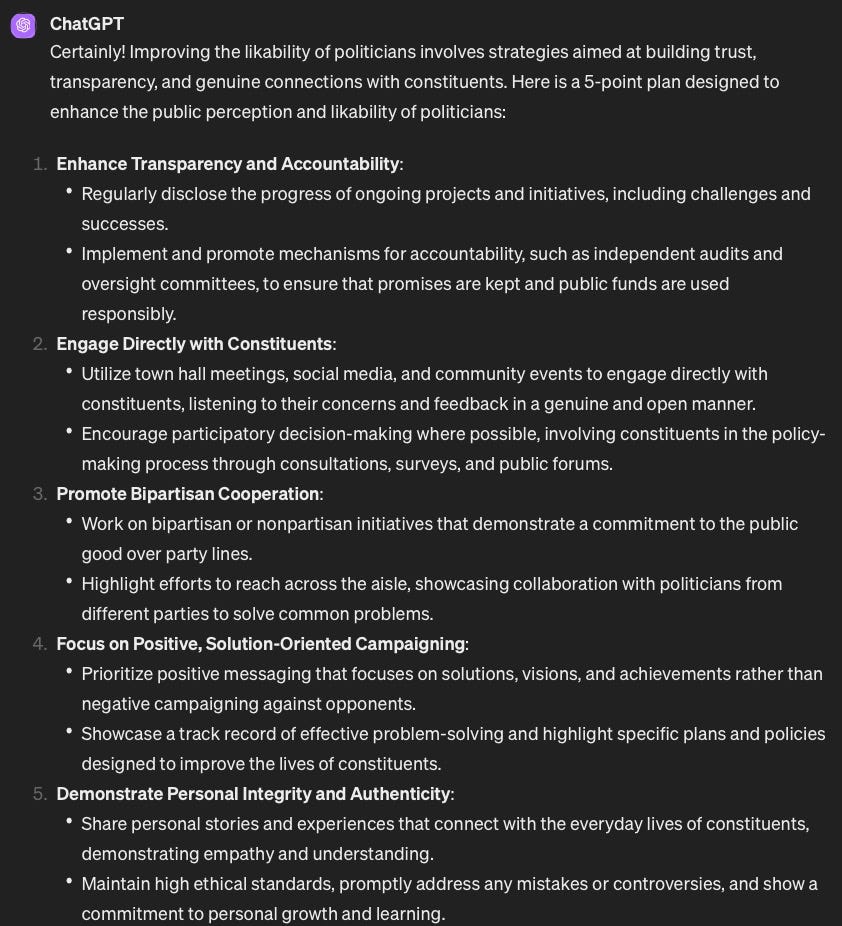
If you’re enjoying Influence With AI, will you take 7 seconds and forward this edition to a friend? It goes a long way in helping me grow the newsletter and helping more people turbocharge their public affairs careers.